

March 26, 2021

The latest Bureau of Labor Statistics (BLS) jobs and labor force data shows the path to recovery remains quite volatile and there is still a long way to climb to reach pre-pandemic Colorado employment levels.
Key Findings – Colorado February 2021 Employment Data
- Colorado added 5,200 total nonfarm jobs in February. This is down compared to the 32,000 jobs added in January.
- Official state forecasts project total jobs to reach pre-pandemic levels by 2022, however, at the level of job growth in February, total jobs would not recover to pre-pandemic levels until early 2024.
- Total employment levels are down 5% relative to pre-pandemic levels, ranking Colorado 27th in terms of February job levels relative to January 2020.
- NY ranked #48, and CA #46 in terms of current job levels relative to January 2020, down 11% and 10%, respectively.
- Idaho and Utah are the only two states that are above pre-pandemic job levels, having added 9,000 and 7,000 additional jobs, respectively.
A Deeper Dive into Colorado Industries
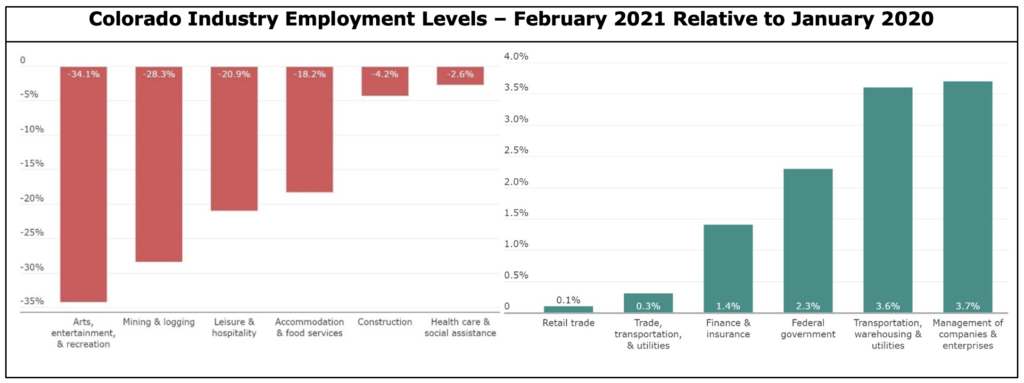
- Some sectors in Colorado added jobs in February, while other declined.
- Leisure and hospitality added 9,700 jobs.
- Professional and business services lost 2,900 jobs.
- While the leisure and hospitality sector led the recovery with adding 8,500 jobs between Jan. 2021 and Feb. 2021, they are still down 73,000 jobs relative to January 2020.
- Arts, entertainment, and recreation is down 34% or 20,000 jobs.
- Accommodation and food services is down 19% or 52,400 jobs.
 Colorado Labor Force Update
Twelve months into COVID-19, most people have been able to adapt to the economy’s new normal. Restrictions are easing, business are finding ways to reopen, and the economy is in the process of rebounding. Similar to the various impacts across industries, the recovery across Colorado’s labor force has not impacted everyone equally.
Key Findings – Colorado February 2021 Labor Force Data
- The unemployment rate remained at 6.6% in February 2021. The economy added jobs, and the statewide labor force increased by .2-percentage points to 68.5% relatively equivalent to the pre-pandemic rate.
- There would be 27,000 more women in the labor force if the January 2020 participation rates were unaffected by the pandemic. What does this mean? Women still have not made a full recovery, despite growth in the female labor force size in the last year.
- The female participation rate remains lower than its pre-pandemic level, yet the male rate has recovered. As of February 2021, the Colorado LFPR for women is 1.2-percentage points below the January 2020 level, compared to the .8 increase for men.
Women and Men, With and Without Kids (25-64 years old) in the Labor Force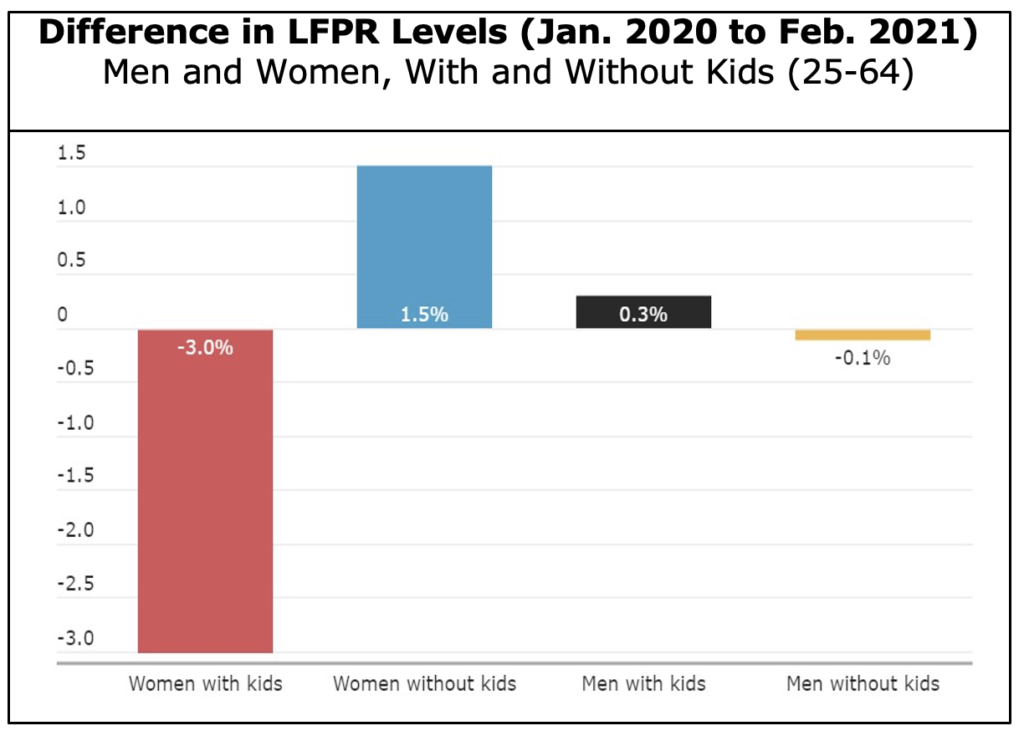
- Mothers between the ages of 25-64, participated in the labor force at a rate 3-percentage points lower than they did prior to the pandemic.
- Younger mothers between 25 and 39 years old had a lower LFPR of 6-percentage points than they did prior to the pandemic.
RECENT/RELATED RESEARCH
Economic Impact of the PMI, ZYN Manufacturing Plant in Aurora, Colorado

Economic Impact of the PMI, ZYN Manufacturing Plant in Aurora, Colorado Key Findings The $1.2 billion PMI, Zyn manufacturing plant…
Homicides Surge in Denver: July is on Pace to be the Deadliest Month on Record

Introduction Crime has a significant impact on a city. It affects its economy, culture and attitude, and impacts the decision…
Colorado Labor Market Update – June 2026

Colorado experienced moderate employment growth over the last month. After losing 400 nonfarm jobs in May, the state added 4,800…
Snapshot of Fees in Colorado: 2026 Update

Introduction Colorado voters approved TABOR (Taxpayer’s Bill of Rights) to limit government revenue growth by requiring voter approval for revenue…