





July 23, 2026
Introduction
Crime has a significant impact on a city. It affects its economy, culture and attitude, and impacts the decision making of both residents and prospective movers. In recent years, Denver’s crime rates remained relatively stable before beginning to decline, but a recent surge in homicides suggests that progress may be stalling.
Between 2024 and 2025, the number of homicides in Denver declined 42%, from 65 to 38.
However, this trend has not continued into 2026, and the city is now on pace for its deadliest month (July) and deadliest quarter (Q3) in Denver’s history.
According to the latest official data available, there have been 35 homicides as of July 20, compared to just 24 at this time last year, an increase of 46%.
While the official Denver Police Department (DPD) dashboard shows nine murders from July 1 through July 20, CSI determined, through analyzing public case information, along with recent comments from DPD Chief Ron Thomas, that at least 10 homicides have occurred.
This report examines recent homicide trends in Denver, including changes in homicide counts over time, the geographic distribution of homicides across neighborhoods, and the extent to which current homicide patterns align with areas previously identified as violent crime hot spots.
This report relies on the Denver Homicide Dashboard, news reports, public case information, and data from the Denver Office of the Medical Examiner and the Denver Police Department, some of which was compiled by The Denver Post.[i][ii]
Key Findings
Denver is on pace for its deadliest month and quarter ever
- CSI, using public case records and a recent statement from DPD Chief Ron Thomas, has determined there have been at least 10 homicides from July 1 through July 20.
- If this pace continues through the month, Denver will record 16 homicides in July, more than any other month in Denver’s history and beating out July of 2020 when the city recorded 15 murders.
- With July on pace to become Denver’s deadliest month, the city is also on pace for a record 46 homicides in Q3, surpassing the 42 recorded in Q3 2020. So far this July, Denver has recorded a homicide on average every other day.
Year-to-date, homicides in Denver have increased dramatically
- Through July 20 of this year, the number of official homicides in Denver increased by 46% compared to the same time last year.
- Homicides year-to-date increased from 24 in 2025 to 35 in 2026.
Denver’s Q3 is on pace to have more homicides than all of 2025
- Denver recorded just 38 homicides in all of 2025, meaning the city’s current Q3 pace of 46 murders would exceed last year’s full-year total.
- The 10 murders recorded during the first 20 days of July equal 26% of Denver’s total murder count in 2025.
A Deadly Month for Denver
The official tally of homicides in Denver stands at 35 year-to-date, and nine in the month of July (July 1 through July 20). To get a more up-to-date count, CSI analyzed public case records and found there had been five confirmed homicides from July 1 through July 14 and that during a press conference held on the morning of July 20, DPD Chief Ron Thomas stated that it had been a “troubling situation this weekend [weekend of the 17th] with five deaths, maybe six.”[iii]
Using these two sources, CSI can report that from July 1 to July 20, Denver experienced at least 10 homicides, if not more, given the DPD Chief’s statement.
Given there are 31 days in July, 10 murders through the first 20 days puts Denver on pace to record 15.5, or approximately 16, homicides in the month of July, the most ever, narrowly edging out July of 2020 when the city saw 15 murders.
Figure 1
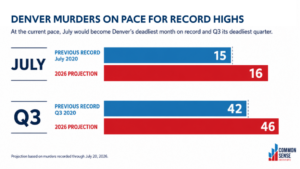
The violent pace also puts Denver on track to have the deadliest quarter on record. Assuming July’s homicide rate continues, the city would tally 46 homicides in Q3, beating Q3 of 2020’s total of 42.
Homicide Trends in Denver
Following a particularly violent weekend that saw 15 injuries and “five or six” deaths stemming from six shootings between Friday evening and Monday morning, Denver has now officially recorded 35 homicides year-to-date, and the city is now poised to see yearly homicides rise once again.[iv]
The uptick comes on the heels of four consecutive years of declining homicide totals and signals that the post-Covid dampening of violent crime may be coming to an end.
Table 1 shows the number of homicides that occurred in Denver per year since 2021 and the rate of change from the previous year. Denver’s homicide rate has declined in each of the last four years, but 2025 was a particularly positive year; Denver’s homicide rate dropped 42% from 2024.
Table 1
| Number of Denver Homicide Victims by Year (2021-2026) | ||
| Year | Number of Homicide Victims | Change from Previous Year |
| 2021 | 96 | |
| 2022 | 88 | -8.3% |
| 2023 | 85 | -3.4% |
| 2024 | 65 | -23.5% |
| 2025 | 38 | -41.5% |
| 2026* | 35 | |
*Count current as of July 20, 2026
According to the Denver Police Department Dashboard, in 2025, there were 38 total homicides. From January 1, 2026, to July 20, 2026, the total count of homicides stood at 35. Over the same period in 2025, the number of total homicides was 24, a 45.83% increase from 2025 to 2026.
Figure 2
Figure 2 depicts homicides by quarter in Denver. While both Q1 and Q2 of 2026 were above their respective 2025 levels, 2026’s Q3 pace is projected to be higher than any quarter on record.
Mapping Denver Homicides
Figure 3 below shows the geographic distribution of homicides across Denver neighborhoods. The map shows 30 homicides and does not include the latest official DPD dashboard update that brought the total count to 35.
Figure 3: Map of Homicides in Denver Neighborhoods (2026)
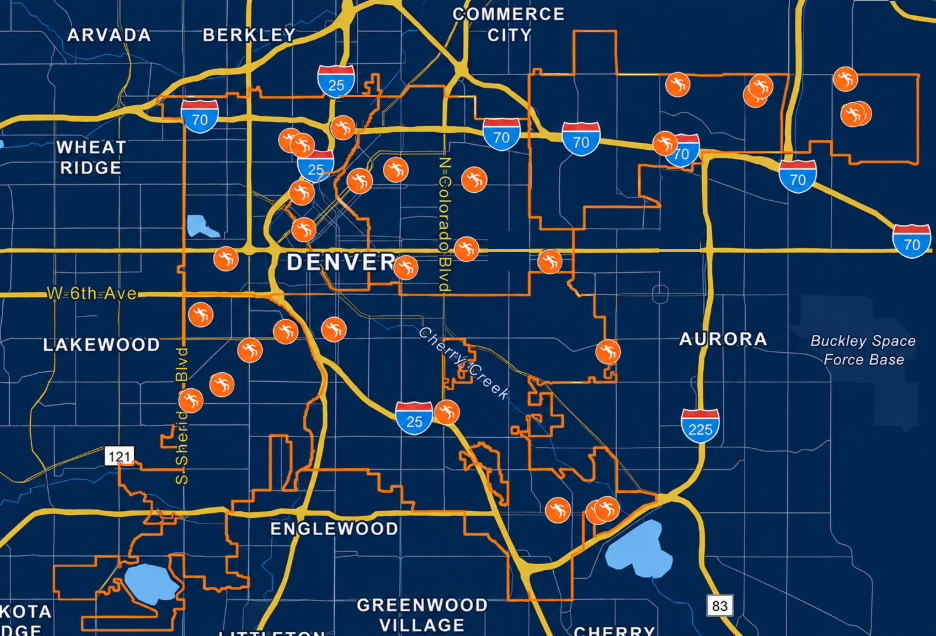
Source: City of Denver Performance and Transparency Dashboard Homicide Map. Due to data limitations, only 30 homicides are depicted.
Table 2: 2026 YTD Denver Homicide Street Intersections[1]
| Police District | Address |
| 1 | W 13th Ave and Lowell Blvd |
| 1 | N Pecos and W 44th Ave |
| 1 | W 42nd Ave and N Lipan St |
| 1 | N Sherman St and E 46th Ave |
| 1 | N Speer Blvd and Larimer St |
| 2 | Lawrence St and 32nd St |
| 2 | E 36th Ave and N Gaylord St |
| 2 | N Forest St and E 33rd Ave |
| 2 | E Colfax Ave and N Dahlia St |
| 2 | E 11th Ave and Columbine St |
| 2 | E 12th Ave and N Tamarac St |
| 3 | W Maple Ave and S Broadway |
| 3 | E Iowa Ave and S Albion St |
| 3 | S Fulton St and E Virginia Ave |
| 3 | S Galena St and E Hampden Ave |
| 3 | S Dayton St and E Hampden Ave |
| 3 | Ulster St and E Hampden Ave |
| 4 | N Vrain St and W 1st Ave |
| 4 | S Federal Blvd and W Virginia Ave |
| 4 | W Maple Ave and S Raritan St |
| 4 | S Newton St and W Arizona Ave |
| 4 | S Xavier St and W Florida Ave |
| 5 | E 49th Ave and N Flanders Way |
| 5 | E Robins Dr and N Cathay St |
| 5 | Maxwell Pl and Pensacola Dr |
| 5 | Chambers Rd and 53rd Ave |
| 5 | Tucson St and Olmsted Pl |
| 5 | Quentin St and E 44th Ave |
| 5 | Argonne St and E 48th Pl |
| 6 | 20th St and Little Raven St |
*These locations are not exact. They reflect the nearest intersection to each homicide.
Several neighborhoods, including Five Points, Cole, and Northeast Park Hill, are located near Denver’s urban core. Meanwhile, other high-homicide neighborhoods such as Gateway–Green Valley Ranch and Hampden are farther from downtown. The map above indicates that homicides are occurring in both central and outlying areas of the city, rather than being concentrated in one region.
Historical Homicide Hotspots in Denver
In 2022, the City of Denver announced a targeted initiative to address crime in five identified hot spots based on the number of homicides and aggravated assaults in 2020.[v] [vi] The designated locations included:
- South Federal Boulevard and West Alameda Avenue
- Colfax Avenue and Broadway
- East Colfax Avenue and Yosemite Street
- East 47th Avenue and North Peoria Street
- Martin Luther King Jr. Boulevard and North Holly Street
Through the initiative, the city sought to expand place-based policing by combining focused law enforcement efforts with partnerships involving neighborhood organizations and community members to address factors contributing to crime in specific areas.[vii]
- Approximately four years after implementation, the identified hot spots have experienced varying levels of change. Through July 7 of this year:
- A homicide occurred approximately 0.3 miles from the South Federal Boulevard and West Alameda Avenue hotspot near South Federal Boulevard and West Virginia Ave.
- The East 47th Avenue and North Peoria Street hot spot was associated with two nearby homicides occurring approximately 0.5 miles and 1.6 miles from the original location.
- One homicide occurred approximately 0.4 miles from the Martin Luther King Jr. Boulevard and North Holly Street hot spot.
These findings suggest that several areas identified as hot spots continue to experience homicides.
It also appears that violent crime has expanded beyond the hot spots identified by the city several years ago.
Public Safety Polling in Denver
In 2023, the City of Denver conducted a public safety survey across the city’s seven police districts and 78 neighborhoods to better understand residents’ perceptions of crime and safety. The survey was designed to inform neighborhood-specific public safety strategies and identify community concerns at the local level.
The indices analyzed in the survey included drugs and alcohol, homelessness, police capacity, community capacity, property crime, public order crime, quality of life, traffic safety, and violent crime. Homicides were a concern under the violent crime category.
The following percentages of respondents identified homicides as a public safety concern in their respective police districts:
- Police District 1: 16.23% of respondents
- Police District 2: 21%
- Police District 3: 7%
- Police District 4: 13.01%
- Police District 5: 10%
- Police District 6: 23.47%
- Police District 7: 3%
Districts 6 and 2 reported the highest levels of concern about homicides, while Districts 7 and 3 reported the lowest. These findings highlight how perceptions of violent crime vary across Denver.
Among the neighborhoods associated with Denver’s 2022 place-based policing hot spots, concern about homicides also varied considerably:
- Westwood – South Federal Boulevard and West Alameda Avenue: 11.36%
- Capitol Hill – Colfax Avenue and Broadway: 20.07%
- East Colfax – East Colfax Avenue and Yosemite Street: 30.56%
- Montbello – East 47th Avenue and North Peoria Street: 22.22%
- Northeast Park Hill – Martin Luther King Jr. Boulevard and North Holly Street: 14.04%
Notably, East Colfax and Montbello recorded some of the highest levels of concern about homicides among these hot-spot neighborhoods, with nearly one-third and more than one-fifth of respondents, respectively, identifying homicides as a public safety issue.
These results suggest that resident perceptions of violent crime were elevated in several of the areas targeted by the city’s place-based policing efforts.
Bottom Line
Following Covid, Denver, along with most other major cities, experienced a decline across a wide spectrum of crime categories. Prior to 2026, homicide totals in Denver had declined for four consecutive years, with a dramatic 42% decline from 2024 to 2025.
Yet this positive trend has seemingly evaporated in 2026, and the city is now on pace for its deadliest month and quarter ever, already unofficially recording 10 murders in just the first 20 days of the month. This report shows that homicides continue to be somewhat clustered in certain areas, and residents who live in typically more violent areas report feeling homicides are a public safety concern at much higher rates than Denverites in other police districts.
While the Denver Police Department has worked to curb homicides in part through place-based policing, it’s unclear to what extent this has been effective against the larger backdrop of declining crime rates post-Covid.
With Denver’s 2026 homicide total projected to surpass 2025 within the month of July, public safety officials will need to work to ensure residents feel safe, and that the upward trend shown in this report doesn’t continue.
[i] Performance and Transparency – City and County of Denver
[ii] Denver Homicide Report | The Denver Post
[iii] WATCH: DPD Chief Ron Thomas presser on deadly shooting
[iv] Denver police chief calls violent weekend with 15 shooting victims ‘unusual’
[v] https://www.9news.com/article/news/crime/denver-crime-hotspots/73-1e73ef1c-1a96-433c-88ad-e7b7b2b10ea3
[vi] https://www.denver7.com/news/local-news/denver-releases-new-action-plan-to-address-rising-crime-in-city
[vii] https://ewscripps.brightspotcdn.com/e1/4d/c1f1248f47e58c9ea00b0fd0de6b/2022-public-safety-action-plan.pdf
[1] The map reflects 24 homicide incidents, not total victims. The total number of homicide victims during the period analyzed is 27.
RECENT/RELATED RESEARCH
Colorado Labor Market Update – August 2026

Colorado Labor Market Update – August 2026 Summary Colorado lost 1,400 nonfarm jobs in August, reversing the moderate growth seen…
Dollars and Data 2026

Introduction Now mostly free from the specter of COVID-19, Colorado’s public education system is still struggling: in 2026, enrollment fell…
The Economic Impact of Hunting and Fishing and Its Connection to Amendment 83 – The First in a Two Part Series

The Economic Impact of Hunting and Fishing and Its Connection to Amendment 83 – The First in a Two Part…
Proposition 137: Sporting Goods Sales Tax Revenue for Conservation

Proposition 137: Sporting Goods Sales Tax Revenue for Conservation Introduction Proposition 137 would exempt existing state sales tax revenue on…