


October 5, 2026

Experts:
13 Outcomes: How Amendment 87 Would Affect Colorado’s Economy & Residents
Introduction
Colorado has had a flat tax for both individual and corporate income for nearly 40 years, but that regime could end this November when voters decide whether or not to abandon the current 4.4% flat income tax system for a progressive structure.
Amendment 87, formerly known as Initiative 195, suggests increasing the top rate on individuals, estates, trusts and C corporations and creating a set of graduated rates ranging from 3.7% to 8.4%.
This report builds on the June research by outlining other potential outcomes from enactment of Amendment 87. These 13 observations include a longer (10- and 20-year) time horizon regarding outmigration.
Amendment 87 proposed rate schedule
| Federal taxable income | Current rate | Rate under Amendment 87 |
| Up to $25,000 | 4.40% | 3.70% |
| $25,001 – $100,000 | 4.40% | 4.20% |
| $100,001 – $500,000 | 4.40% | 4.40% (unchanged) |
| $500,001 – $750,000 | 4.40% | 7.40% |
| $750,001 – $1,000,000 | 4.40% | 7.90% |
| Over $1,000,000 | 4.40% | 8.40% |
Table 1: Comparison of Tax Rates, Flat Tax and Amendment 87
State economists estimate the new system would raise taxes by $2.0 billion in FY 2028, according to the Blue Book.[i] The revenue impact of Amendment 87 is a moving target given that revenue forecasts change frequently with updated filing information and economic indicators. CSI’s prior work suggested a tax increase of $2.3 billion[ii], while the top end of the tax increase in the first year of impact at the time the Blue Book was written was $2.7 billion.[1],[iii] Using $2.3 billion as the baseline for the first full fiscal year (FY) 2028 tax increase and modeling out years 2028 through 2050 results in a cumulative tax increase of $154 billion. This is known as the static tax increase because it is before accounting for high income individuals leaving the state.[2]
Amendment proponents say a progressive tax structure would reduce residents’ tax bills.
That claim might be true for anyone whose tax rate falls to 3.7% from the current 4.4%, but many residents and businesses would pay higher taxes.
As a June 2026 CSI report shows, currently the average resident’s tax and fee burden ranks 37th-highest among states. Amendment 87 would boost that rank to 33rd.[iv]
Tax levies also affect behavior. CSI’s June 2026 report found replacing the flat tax would erode Colorado’s tax competitiveness at a time when that ranking already is waning. In the Tax Foundation’s 2020 State Business Tax Climate Index, Colorado ranked 17th in the country in tax competitiveness. In the 2026 edition, Colorado ranked 33rd.[v] That CSI report addressed the behavioral responses of individuals and businesses, focusing specifically on the effects of higher income tax rates on movement among high earners and firm migration, through a dynamic lens.[vi]
Key Findings
- On net, Amendment 87 would increase income taxes by $154 billion, excluding behavioral-response effects, from FY 2027 (half year) through FY 2050.[3]
- Amendment 87’s tax brackets would not adjust automatically for inflation, so rising nominal incomes will move more taxpayers into higher brackets in future years, even without an increase in purchasing power.
- Unlike a majority of states[vii],[viii], Amendment 87 does not index brackets for inflation. As a result, up to $36 billion of the $154 billion tax increase would come from bracket creep.
- By 2050 the top three brackets (i.e., above $500,000) reach roughly one in eight filers. A household with $250,000 of taxable income today would fall into the $500,000 tax bracket around 2042; a household at $200,000 crosses around 2047.
- From 2027 through 2050, more than $460 billion in S-Corp/pass-through income—including billions of dollars never distributed to the owners in the year earned—would be taxed. CSI estimates these small business owners would pay more than $35.8 billion in taxes, resulting in an effective rate of about 7.8%.
- At most, taxpayers will get a $325 tax cut from Amendment 87. On the other hand, the tax increase is unlimited and eventually will fall on middle-income earners.
- Residents in their 20s now would see the largest increase of any age group. A couple, both aged 29 today, each earning $85,000, and experiencing typical wage growth across their careers, would cross the $500,000 threshold in 2046, at age 49.
- Under Amendment 87, joint filers, including married couples, would pay a penalty to be married. In 2027, about 689,000 joint tax filers (1.8 million individuals, which includes adults and children) would pay an average penalty of $737 and by 2050, about 985,000 joint tax filers (2.6 million individuals) would pay a marriage penalty of $2,900.
- Amendment 87 would create a much less reliable revenue stream, leading to volatility that could impact the state’s ability to pay for education, health care, child care, and other priorities.
- The flaws of Amendment 87 are fixable only if a future legislature gives up money dedicated to education, health care, and child care. For instance, the Legislature could offer inflation indexing of tax brackets, but that would mean giving up $36 billion dedicated for education, health care, and child care.
- Amendment 87 taxes income, not wealth. CSI research indicates the amendment would cause Colorado to lose businesses and jobs. Wealthier residents would be more likely to leave, creating the revenue instability mentioned above.
- In the top three corporate income brackets after 10 years, the state would lose 295 firms that, together, earn more than $2 billion annually and employ roughly 42,000 people. Gains in the number of businesses in the two lower brackets would not be enough to offset these losses.
- In the top three corporate income brackets after 20 years, the state would lose more than 590 firms that, together, earn nearly $4.1 billion annually and employ roughly 84,000 people after 20 years. Gains in the number of businesses in the two lower brackets would not be enough to offset these losses.
13 Observations on Amendment 87
On the surface, the effects of Amendment 87 may seem simple: impose higher taxes on filers with wages and other sources of income above $500,000.[4],[ix],[x] The amendment is presented as a tax on the wealthiest three percent of residents, but it is not a wealth tax. It is actually a tax on working income, phantom income, and regular wage and investment income – not wealth – and as such, will eventually touch hundreds of thousands and soon millions of Colorado residents and businesses.
Indeed, Amendment 87 would result in several intended and unintended consequences like taxing phantom income at a higher rate (i.e., taxing income not received), imposing a marriage penalty, increasing higher taxes on the sale of family farms and small businesses, raising tax rates on moderate income savers, and the largest unintended consequence: increasing tax rates on the middle class over time. As CSI outlined in a June 2026 report, Amendment 87 also would cause departures of businesses and wealthy taxpayers.
Here are 13 outcomes from Amendment 87 that have large economic effects.
1. Some businesses and residents would leave Colorado
Taxing income disincentivizes earning, though the extent to which it does is debated. In at least some cases, differences in income tax rates can repel movers from one state and attract them to another. In a study on federal and state tax progressivity, the Federal Reserve Bank of Minneapolis concludes that “households at all income levels who migrate from one state to another appear to be drawn to states with less progressive tax and transfer systems” and that “lower progressivity appears to be an especially powerful draw for very high income [sic] movers.”[xi]
Therefore, under a structure that lowers taxes for all but the highest-earning filers, wealthy individuals and highly profitable firms may leave while more lower-earning taxpayers arrive. CSI studied and found evidence to support this premise in its June report on Amendment 87.[xii] According to the analysis:
- In the top three individual-income brackets after 10 years, the state would lose 800 residents who, together, earn more than $2.3 billion annually.
- In the top three individual-income brackets after 20 years, the state would lose 1,600 residents who, together, earn more than $4.6 billion annually.
- In the top three corporate-income brackets after 10 years, the state would lose 295 firms that, together, earn more than $2 billion annually and employ roughly 42,000 people.
- In the top three corporate-income brackets after 20 years, the state would lose more than 590 firms that, together, earn nearly $4.1 billion annually and employ roughly 84,000 people.
- Gains in the incomes of individuals and businesses in the lower brackets would not be sufficient to offset losses.
| Projected Annual Impacts of Amendment 87 (Initiative #195) on Net Migration of Individual Filers and Their Earnings | ||
| Bracket # | Net migration of individual filers | Net earnings change (2025 dollars) |
| 1 | Insufficient evidence | Insufficient evidence |
| 2 | 351.44 | $21,859,399 |
| 3 | 114.77 | $23,712,186 |
| 4 | -1.05 | -$786,328 |
| 5 | -1.72 | -$1,786,513 |
| 6 | -77.69 | -$229,093,593 |
| Total | 385.74 | -$186,094,850 |
Table 2: Individual Migration Impact
| Projected Annual Impacts of Amendment 87 (Initiative #195) on Net Migration of Corporate Filers and Their Profits | ||
| Bracket # | Net migration of corporate filers | Net profits change (2025 dollars) |
| 1 | Insufficient evidence | Insufficient evidence |
| 2 | 8.43 | $680,085 |
| 3 | 6.81 | $2,679,503 |
| 4 | -0.35 | -$257,705 |
| 5 | -0.30 | -$300,261 |
| 6 | -28.86 | -$202,447,675 |
| Total | -14.28 | -$199,646,053 |
Table 3: Business Migration Impact
Figure 1: Net Migration Ranking Across States
2. Residents would pay one of the highest income tax rates in the country
One reason residents and businesses may leave Colorado under Amendment 87 is because the graduated income tax would erode the state’s competitiveness.
Colorado’s 4.40% flat tax is lower than every neighboring state that levies an income tax except Arizona. An 8.40% top rate would exceed all seven neighbors and place Colorado among the ten highest rates in the country—near Vermont, and just below Oregon and Minnesota. Wyoming levies no income tax at all and is less than an hour’s drive from Fort Collins. Texas, Nevada, and South Dakota also have no income tax. Individuals and business owners may decide to move to states that are more hospitable.
Figure 2: Income Tax Policy Choices Across States
3. Small business owners would pay tax on income they have not received and may never receive
Federal law taxes the owner of an S corporation or partnership on their share of the profit whether or not a single dollar is distributed. Internal Revenue Code §1366(a)(1)[xiii] contains no condition that a distribution be made, and Colorado inherits that number automatically because the state return begins at federal taxable income. Today, phantom income is taxed at 4.40%.[xiv] Under Amendment 87 it would be taxed at up to 8.40%—and a minority owner of a pass-through business usually cannot force a distribution to pay the bill.[5]
| Income not distributed in the year earned (and may never be distributed) and the tax on it (modeled)[xv] | 2027 | 2040 | 2050 |
| Estimated returns taxed on undistributed income | 190,180 | 336,943 | 543,138 |
| Income taxed but not received in the same tax year | $6.4B | $18.5B | $42.0B |
| Tax paid on that income | $482M | $1.44B | $3.33B |
| Dependents in those households | 94,817 | 166,394 | 268,101 |
Table 4: Phantom Income Summary Statistics for All Filers
All of the increase falls on returns reporting more than $500,000 in taxable income. A return crosses that line on paper while the person behind it may have received a fraction of that taxable income in cash.
| Breakout: returns reporting more than $500,000 (modeled) [xvi] | 2026 | 2040 | 2050 |
| Phantom income on those returns | $5.3B | $16.3B | $38.9B |
| Tax on it under Amendment 87 | $434M | $1.34B | $3.19B |
| Tax on the same income at today’s 4.4% | $223M | $719M | $1.71B |
| Increase caused by Amendment 87 | $201M | $621M | $1.48B |
| Change in tax liability for returns under $500,000 with phantom income | -$0.2M | -$0.2M | -$0.2M |
Table 5: Phantom Income Summary Statistics for Returns Impacted by Amendment 87
Between 2026 and 2050, more than $460 billion in S-Corp/pass-through income—including billions of dollars never distributed to the owners—would be taxed. CSI estimates these small business owners would pay about $35.8 billion in taxes, resulting in an effective rate of about 7.8%.
4. Amendment 87 creates a new marriage penalty
Colorado’s flat tax does not penalize marriage. It treats singles and married couples equally, at least when it comes to the top marginal tax rate. Under a single rate, a couple pays exactly the same rate filing jointly or separately, so the rate schedule creates no marriage penalty, meaning the penalty for being married is zero.[6]
For example, a married couple where each party earns $280,000 would file one joint return showing $560,000 in income and, under Amendment 87, would owe the top 7.4% rate on their last $60,000 in income. The federal government doubles its joint thresholds specifically to prevent this; Amendment 87 does not.
The marriage penalty is also not confined to high earners. Because combining income moves more income from, for example, the 3.7% rate into the 4.2% band, nearly half of all Colorado joint returns would pay a marriage penalty from day one. Additionally, when income crosses the $25,000 and $100,000 lines, where the rate step is a fraction of a point, individuals pay a marriage penalty as well, even if the tax rate is lower than the current 4.40%.
From 2027 to 2050, purely based on joint filing data, Amendment 87 would impose a marriage penalty on $733 billion in income pushed above the $500,000 threshold, leading to $32.7 billion in additional tax owed solely because two people are married.[7]
In 2027, about 689,000 joint tax filers (1.8 million individuals, which includes adults and children) would pay an average penalty of $737 and by 2050, about 985,000 joint tax filers (2.6 million individuals) would pay a marriage penalty of $2,900. These values, and those in the following table, are upper bounds because they do not reflect deductions and credits that may be available to couples who choose to file separately instead under the new rates.
| The marriage penalty (modeled)[xvii] | 2027 | 2040 | 2050 |
| Joint returns paying a penalty | 688,943 | 857,038 | 985,012 |
| Income pushed into the top brackets by joint filing | $10.0B | $29.5B | $67.6B |
| Tax owed because of it | $508M | $1.33B | $2.86B |
| Average per penalized couple | $737 | $1,552 | $2,906 |
| Children and dependents in those households | 427,145 | 531,364 | 610,707 |
Table 6: Marriage Penalty Summary Statistics
5. Amendment 87 would make school funding less stable, not more
Amendment 87 is often offered as a method to provide a reliable stream of funding for education, health care, and childcare. That assertion – that the measure increases a reliable stream of revenue – stems from the fact that the measure raises taxes, not that the revenue source is more reliable than other sources. A graduated tax concentrated on top earners is among the least stable of the major revenue sources a state can choose. For instance, California’s legislative analyst found its personal income tax is roughly five times more volatile than personal income itself, with about 40% of that volatility traceable to the progressive rate structure. Income above $150,000 swings about seven times as much as income below it.[xviii]
Amendment 87 would shift Colorado sharply in that direction. Under today’s flat rate, the top three brackets would supply about 28% of income tax revenue in 2027. Under Amendment 87, they would supply 38% immediately, and 65% by 2050 because bracket creep would keep pushing filers upward. This outcome means funding for education, health care, and childcare would become even more exposed to the effects of a recession—and the volatility of the revenue stream would grow over time.
| Recession exposure (modeled downturn: a 30% fall in income in the top three brackets and a 3% fall in wages)[xix] | 2027 | 2040 | 2050 |
| Share of revenue from the top three brackets | 38.0% | 51.5% | 64.9% |
| The share under today’s flat 4.4% | 28.1% | 40.7% | 54.6% |
| Revenue lost in the modeled downturn | $2.12B | $6.15B | $14.11B |
| Extra loss created by Amendment 87 | $0.57B | $1.80B | $4.31B |
Table 7: The Volatility of Revenue Connected with Amendment 87
6. More residents would be subject to the top tax rate over time
Under TABOR, residents get to vote on tax increases, but Amendment 87 would allow for an automatic annual increase in the share of income exposed to higher tax rates on residents. Here is why: the $500,000 threshold is a fixed nominal number—it is not indexed to inflation. Wages are not fixed. Voters would approve a schedule with fixed income thresholds. As nominal incomes rise, more income could enter higher brackets without further changes to that schedule.[xx]
By voting for Amendment 87, voters would be approving a schedule whose fixed thresholds produce a rising effective tax burden in each of the 24 years through 2050.
By 2050, the top three brackets would reach roughly one in eight taxpayers. A household with $250,000 of taxable income today would cross into the 7.4% bracket around 2042 assuming 4.5% income growth and 2.5% inflation growth. A household with $200,000 income today would cross into that bracket around 2047 using the same income and inflation figures.
Both households are being promised a tax cut, but would face higher taxes over the coming years, paying thousands more than they would under today’s flat tax rate.
| 24 years of tax increases (modeled)[xxi] | 2030 | 2040 | 2050 |
| Extra tax owed because brackets are frozen | $185M | $1.61B | $6.11B |
| Cumulative since 2027 | $349M | $8.92B | $45.66B |
| Per Colorado return | $51 | $401 | $1,377 |
| Share of all Colorado income tax | 1.0% | 4.4% | 8.9% |
Table 8: Bracket Creep Summary Statistics
| Who ends up in the top brackets[xxii] | 2027 | 2040 | 2050 |
| Share of filers in the top brackets | 2.2% | 6.0% | 12.9% |
| Filers in the top brackets | 78,697 | 241,719 | 571,645 |
| People living in those households | 186,369 | 560,709 | 1,301,829 |
| Children and dependents in those households | 44,407 | 133,689 | 310,472 |
| $500,000 in 2026 purchasing power | $487,805 | $353,864 | $276,438 |
Table 9: Who Ends Up in the Top Brackets
7. Taxes on small businesses, marriage penalty, and bracket creep drive revenue growth
Of the $108 billion Amendment 87 would raise from just the individual income tax between FY 2027 and FY 2050, about $33 billion would stem from taxing current income above $500,000 at 7.4% to 8.4% rather than today’s 4.4%. The remaining $75 billion increase is associated with three features of the drafting. Each is measured separately against a differently drafted version of the same measure, so they overlap: their sum is an upper bound rather than a partition, and the $33 billion residual is correspondingly a lower bound on the rate change’s own contribution. These should be quoted individually rather than as exclusive shares:
- Brackets not indexed to inflation: $36 billion, or 32.9% of the increase.
- Marriage penalty: $27 billion, or 25% of the increase.
- Tax on undistributed pass-through income: $13 billion, or 11.8% of the increase.[8]
8. Later changes to the tax bracket could reduce projected revenue
In theory, Amendment 87 leaves the rates and thresholds in statute, not in the constitution, and under the Taxpayer Bill of Rights (TABOR), the legislature may cut taxes without a vote by the people. In other words, the legislature could index brackets for inflation or eliminate the marriage penalty at any time.[xxiii]
But to do that, the legislature would have to give up money. Correcting Amendment 87’s flaws later means a future legislature voluntarily surrendering revenue it has come to depend on to fund schools or health care.
9. Selling a business or stocks, moving retirement funds could trigger higher taxes
Amendment 87 looks at a single tax year, not a lifetime. A family whose income has never approached $500,000 could cross the line once or more times, including during one of the most important financial events of their lives. For example, a family that sells its farm with a $900,000 gain would owe $14,875 more in taxes than it would under today’s rate. This figure is, of course, before any existing subtraction. A farmer who qualifies for Colorado’s agricultural capital gain subtraction—up to $100,000 for land classified as agricultural by the county assessor, held at least five uninterrupted years, by a taxpayer required to file IRS Schedule F—would owe about $11,375 more instead.[9],[10]
Family farmers are not the only ones who could be affected by a one-time sale (see Footnote 6). Selling a medical practice or a contracting business, a Roth IRA conversion, exercising stock options, or a large IRA withdrawal also could push a taxpayer into a higher tax bracket for one year.
| One-time event | Ordinary income | One-time gain | Extra tax |
| Family farm sold after three generations | $70,000 | $900,000 | $14,875 |
| Dental or medical practice sold at retirement | $180,000 | $900,000 | $19,125 |
| Owner sells a contracting business | $95,000 | $750,000 | $10,500 |
| Ranch land sold to fund retirement | $60,000 | $650,000 | $5,975 |
| Roth conversion in one year | $70,000 | $600,000 | $4,775 |
| Inherited property sold by the heirs | $65,000 | $600,000 | $4,625 |
| Stock options exercised after 20 years | $140,000 | $500,000 | $3,875 |
| Large IRA withdrawal for assisted living | $55,000 | $500,000 | $1,325 |
Table 10: Examples of When Moderate Earning Individuals See a Much Larger Tax Bill
10. Selling a rental home would come with a larger tax bill
Amendment 87 has a carve-out for a principal residence, but a close reading of the text makes it clear the carve-out covers the gain on a primary home above the federal exclusion, and nothing else. It does not cover a rental, for example, or a second home in the mountains. It also does not cover an inherited property, farmland, or a small landlord’s duplex.
In a state where property has appreciated the way Colorado’s has, many ordinary families and investors hold those assets—and will see a tax increase when the property is sold.
11. Amendment 87 taxes income rather than wealth and likely would not reduce income inequality
Amendment 87 taxes income, not wealth. A Coloradan whose fortune sits in appreciated stock, real estate, or a private company owes nothing more under this measure until they decide to sell. That decision is theirs, and they can wait. Indeed, IRS data confirms they will. A 2023 paper by McClelland and Smith found that high wealth households adjust when they realize gains in response to tax rates, with an estimated elasticity around -0.60 for millionaires.[xxiv]
Now consider a surgeon in Aurora, a software engineer in Boulder, a nurse practitioner in Pueblo who finally made it to the top of the pay scale. Their income arrives on a W-2. They cannot defer it, time it, or hold it. They pay the full increase every year, without exception.
The result: Amendment 87 collects consistently from people who work for what is currently a lot of money[11], and it only occasionally taxes people who own a lot of things. Whether the measure would on balance reduce income inequality is a heavily debated proposition. For instance, recent research from the Federal Reserve Bank of Dallas finds that increased progressivity may raise after-tax disposable income at the bottom end of the income spectrum and reduce after-tax disposable income at the top end of the earning ladder, but the resulting expansion lifts capital income enough that the 99th-to-50th percentile gap widens.[xxv] Other studies have debated from the opposite perspective on the issue.[xxvi],[xxvii]
12. Amendment 87 is a big tax increase for Colorado’s youngest residents
As noted previously, the $500,000 threshold is not indexed to inflation. It will not expand with a resident’s wages. Earnings growth is fast in the first decade of a career and slower thereafter.[xxviii] As the table below shows, taxpayers who are in their twenties now will fall into the higher tax brackets by the time they are in their 40s or 50s.
| Profile in 2026, earning… | Crosses $500,000 in Year and Age[xxix] | The $500,000 threshold in 2026 earnings terms (deflated at 4.5% wage growth, not at 2.5% inflation: this asks what income today occupies the same position in the distribution, not what it buys) |
| $85,000 each, as a couple, age 29 | 2046 / 49 | $207,321 |
| $60,000 each, as a couple, age 27 | 2053 / 54 | $152,346 |
| $90,000, engineering or tech, age 25 | 2057 / 56 | $127,751 |
| $75,000, medicine or law, age 26 | 2058 / 58 | $122,250 |
| $70,000, typical professional, age 25 | 2065 / 64 | $89,833 |
Table 11: When Wage Earning Individuals or Couples Reach the Top Bracket
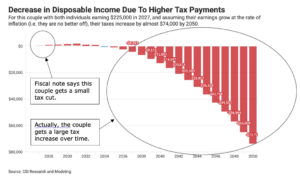
13. Tax cuts diminish over time, but tax increases continue indefinitely
If a resident’s wages continue to grow – and they typically do – under Amendment 87 their tax cut will diminish over time and, eventually, may become a tax increase. Because Amendment 87 rates are not indexed to inflation, the tax cut from reducing the bottom two brackets reaches $325 at $100,000 of taxable income and never grows again. By 2050, that $325 tax cut would total just $184 after accounting for inflation.
How a Couple’s Initial Tax Cut Could Become a Tax Increase Over Time
As a concrete example of where an initial tax cut becomes a tax increase, consider a couple in their 30s, each earning $225,000 per year. Among married households filing jointly, this dual-earning household wouldn’t even make the top 5%.[xxx]
- The household has $450,000 of taxable income in 2027. In this initial year, the couple sees a $325 tax cut.
- Now, suppose the couple’s income grows by the rate of inflation, 2.5%. They are no better off – just keeping up with inflation, but by 2050 would be paying $8,718 more in income taxes. Cumulatively, the couple is paying $73,325 more in income tax. In total, the couple will have paid from 2027 through 2050 $713,835 in income tax. They are worse off by a large margin.
Figure 3: Fiscal Note Says a Small Tax Cut–Actually, this Young Couple Sees a Large Tax Increase Over the Coming Years
Bottom Line
Amendment 87’s fixed income thresholds will bring more Colorado taxpayers into higher tax brackets over time, including younger workers and middle-income households as their nominal incomes rise. Business owners reporting undistributed profits and taxpayers realizing one-time gains from selling a business, farm, or investment property could also face higher taxes. Couples filing jointly could owe more than two single filers with the same combined income.
Higher top marginal rates could affect Colorado’s tax competitiveness and incentives for work, investment, and business growth. They could also encourage some residents and businesses to relocate, with potential consequences for employment, earnings, and the state’s tax base. These effects would depend on taxpayer responses, income growth, and future legislative changes.
Methodology and Sensitivity Appendix
What the model is
Every figure in this report comes from a simulation model of Colorado income tax returns. The distribution of returns by filing status, income group, and pass-through status is fitted to the Colorado Department of Revenue 2024 Tax Profile and Expenditure Report[i], Individual Statistics of Income Tables 1, 3 and 4, full-year residents[ii]. Each cell of that grid is aged forward to 2050 and taxed twice: once under today’s 4.40% flat rate and once under the Amendment 87 schedule as filed.
Every result in this report is the difference between those two scenarios.
Three assumptions drive the projection. Nominal income per filer grows 4.5% per year. The number of returns grows 1.0% a year, so aggregate income grows about 5.5%. Inflation is 2.5%, the rate that indexes the federal standard deduction, and it is used both for constant-dollar figures and for the indexed counterfactual that measures bracket creep. The static model presented here has no behavioral response modeled, e.g., there is no migration, no retiming of income, no entity restructuring, and no switching to married filing separately. Each of those would reduce the later years, so the totals here are an upper bound based on current assumptions. The actual tax increase amount could be higher or lower.
Two scales, and which figures use which
The filer model covers the individual income tax only. The fiscal note also captures C corporations, estates and trusts, and is therefore larger. The figures that must line up with the fiscal note—the $154 billion headline, the $36 billion that arrives, and the component shares in Observation 7—are built up rather than scaled. The individual increase is multiplied by 0.899, the factor that puts the model’s first full year on published individual collections, and the corporate increase is then added separately so that the two together equal the estimated $2.3 billion tax increase for FY 2028.
Figures that are properties of individual filers are not scaled, because the factor reflects entity coverage to match the fiscal note. Phantom income, the marriage penalty, the counts of returns and people, the recession exposure and the per-household arithmetic are all stated based on the filer model. The same quantity therefore appears at two sizes in two places: bracket creep is $45.7 billion over tax years 2027–2050 at the raw model scale, as shown in the Observation 6 table and $35.5 billion over fiscal years 2027–2050 on the calibrated basis used in the headline fiscal note. The two differ for two main reasons together: the 0.899 calibration takes $45.7 billion to $41.1 billion, and the shift from a tax year to a fiscal year window drops tax year 2050 and picks up only approximately a 5-month slice of tax year 2027, taking it to $35.5 billion. Both are okay, but they are not interchangeable.
How the components are measured
The structural bridge is exact. Amendment 87 differs from a 4.40% flat rate in two ways: three new rates above $500,000 and a cut in the bottom two brackets. Gross increase less the cut equals the net increase, $126 billion less $18 billion is $108 billion, the individual income tax increase before the corporate line is added.
The retention rate, and the one assumption behind it
Phantom income is pass-through profit allocated and taxed to an owner who does not receive it in the year when it’s taxed. Its size turns on one input: the share of pass-through income retained rather than distributed, set at 30%.
That figure is derived from U.S. Treasury Office of Tax Analysis Working Paper 126, “Taxing S Corporations as C Corporations” (Goodman, White and Whitten, November 2024), which measures S corporation payout from linked firm-and-owner microdata—12.3 million firm-year observations for tax years 2018–2021—and reports a 56% income-weighted payout rate on post-tax profits. The Treasury does not publish a retention rate, and the paper contains no verifiable figure. Because the owner’s tax is netted from both sides of Treasury’s ratio, retention equals one minus the payout rate times one minus the owner’s tax rate. At a 56% payout and owner tax rates of 20% to 35%, that gives 28.6% to 35.2%. The 30% used here corresponds to an owner-level tax rate near 31%.[iii]
Every phantom income figure scales linearly with that rate. The counts of affected returns do not, of course, move with it. The Treasury research also suggests that 42% of S corporations, holding 23% of all S corporation income, distribute nothing or less than their owners owe in tax on the income.[iv] This is a direct measure of phantom income. Of note, the Treasury measures S corporations only. The paper does not address partnerships.
Sensitivity
The single most sensitive result is the share of filers reaching the top brackets by 2050. At the published 4.5% income growth it is 12.9%. Across growth assumptions of 3.0% to 6.0% it runs from 5.9% to 27.3%.
Further considerations
The model includes no behavioral response. Please read CSI’s prior research on this subject, focusing specifically on the effect of higher top marginal tax rates on economic migration.[v] All figures are nominal unless an inflation adjustment is mentioned. Also, the career trajectory table deflates at 4.5% wage growth rather than 2.5% inflation. Why? Because it asks what income today occupies the same position, not what it buys.
To repeat again: no migration or dynamic economic response is estimated anywhere in this report’s own model on tax incidence. The migration figures cited in Observation 1 are taken from CSI’s June 2026 report, which modeled them separately. Colorado would become the region’s state with the highest income tax rate, and one should expect a measure of out-migration of high-income filers immediately and over time, as mentioned in the report. The static tax incidence estimates presented in this report—outside of, again, the migration figures—are just that, static.
References:
[1] The $2.7 billion figure is not a so-called mid-point forecast, but the statutory maximum that state law requires Legislative Council staff to put in the ballot question, reflecting possible forecast error in the same fiscal year. See § 1-40-106(3)(g)(II) and art. X, § 20(3)(c).
[2] This number reflects tax increases minus tax cuts.
[3] Around $1.4 billion of the $18 billion tax cut goes to filers with reported income above $500,000.
[4] The break-even point for a tax cut is $510,833 because the income between $0 and $100,000 is taxed less than the income taxed above $500,000. The income between $100,001 and $499,999 is taxed at the current rate.
[5] This last point is true under current law and would be true under Amendment 87.
[6] Of course, differences arising from deductions and credits are not eliminated by a flat rate.
[7] The marriage penalty would not necessarily results in a higher tax burden compared to the flat 4.40%. Suppose a couple with two earners each making $75,000 files a joint return. For the moment, and only for illustration purposes, the couple would pay a Colorado state tax of $6,600 currently. Under Amendment 87, if they filed separately, they would pay $6,275, a reduction of $325. But also under Amendment 87, if they filed separately, they would pay a combined $6,050, which is lower than the $6,275 they would pay as a married couple under Amendment 87. This couple would therefore be better off filing separately than as a married couple under Amendment 87 even if they get a marginal tax cut initially with Amendment 87. And as a reminding note: This couple is likely worse off over time as their wages grow over the couple’s careers.
[8] These three are measured one at a time against a differently drafted version of the same measure, so they overlap and their sum is an upper bound rather than a partition. They should be quoted individually. The estimated total revenue increase is $154 billion. What is not in doubt is the direction: much of the new income tax revenue does not come from the rate increase the ballot describes.
[9] For some farmers, the tax increase would be $14,875 because of the narrow requirements of Colorado’s agricultural capital gain subtraction while others would qualify for the lower $11,375 tax increase. See https://tax.colorado.gov/sites/tax/files/documents/ITT_Colorado_Capital_Gain_Subtraction_Jun_2024.pdf.
[10] The other rows likewise exclude any applicable state subtractions, and the inherited property row assumes a taxable gain measured after the step-up in basis rather than the sale process.
[11] In 20 years, the $500,000 threshold will not have the same effect the way it would in 2027 given the rise in wages and other sources of income.
[i] https://leg.colorado.gov/ballots/graduated-income-tax-2/files/blue-book
[ii] https://commonsenseinstituteus.org/wp-content/uploads/2026/06/CSI-Report-CO-Progressive-Tax-Structure.pdf
[iii] https://leg.colorado.gov/ballots/graduated-income-tax-2/files/blue-book
[iv] Gamm, Erik and Ross Kaminsky. “How Initiative #195’s Progressive Tax Structure Would Affect Colorado’s Economy.” Common Sense Institute, June 16, 2026.
[v] Ibid
[vi] https://commonsenseinstituteus.org/research/how-initiative-195s-progressive-tax-structure-would-affect-colorados-economy/
[vii] https://taxfoundation.org/wp-content/uploads/2025/05/State-Booklet-2025.pdf
[viii] https://taxfoundation.org/data/all/state/state-income-tax-rates-2026/
[ix] https://leg.colorado.gov/ballots/graduated-income-tax-2
[x] https://leg.colorado.gov/ballots/graduated-income-tax-2/files/blue-book
[xi] Fleck, Johannes, Jonathan Heathcote, Kjetil Storesletten and Giovanni L. Violante (2025). “Fiscal Progressivity of the U.S. Federal and State Governments.” Federal Reserve Bank of Minneapolis Staff Report 663, January 16, 2025. Also issued as NBER Working Paper 33385, January 2025.
[xii] https://commonsenseinstituteus.org/research/how-initiative-195s-progressive-tax-structure-would-affect-colorados-economy/?utm_source=chatgpt.com
[xiii] https://uscode.house.gov/view.xhtml?edition=prelim&hl=false&num=0&req=granuleid%3AUSC-prelim-title26-section1366
[xiv] https://tax.colorado.gov/sites/tax/files/documents/DR0104_2025.pdf
[xv] The phantom income estimates stem from a model on undistributed income from S-corporations, available here: https://home.treasury.gov/system/files/131/WP-126.pdf. This is then modeled for Colorado based on reported pass-through income from the Department of Revenue.
[xvi] Ibid
[xvii] This models the number of returns by filing status based on Department of Revenue (DOR) filing statistics. Modeling returns with the brackets published by the DOR is done using lognormal and Pareto distributions given the skewed nature of tax return data.
[xviii] https://lao.ca.gov/Publications/Report/3703
[xix] The recession impact stems from the nature of Amendment 87, where it imposes a growing tax on filers reporting high income. These individuals often have lumpy income streams, as mentioned in the California study. For Colorado, the model stems from the assumptions on wage growth, the growth in phantom income and other income earned by filers with reported taxable income above $500,000, and assumptions about the growth in tax returns. The sources for these statements stem from the Colorado Department of Revenue, the IRS, and the U.S. Treasury. No single recession is identical. The recession scenario presented in this report assumes a 30% drop to the top three brackets’ income and a 3% drop in wages. Wages tend to be much more stable compared to other types of income.
[xx] https://content.leg.colorado.gov/sites/default/files/2026-bluebook-english-accessible_1.pdf
[xxi] The two key assumptions for this section are that wage income grows at 4.5% each year and that the number of tax filers in the state grows at 1%.
[xxii] This assumes nominal income growth of 4.5%, inflation of 2.5%, and lognormal/Pareto distribution of filers’ income within published tax return data. The depends figure is estimated per filer type, which stems from the Colorado Department of Revenue.
[xxiii] https://content.leg.colorado.gov/sites/default/files/R26-757_The%20TABOR%20Limit.pdf
[xxiv] https://www.irs.gov/pub/irs-soi/24rpdomillionairesadjustrealizations.pdf
[xxv] Tax Progressivity, Economic Booms and Trickle-Up Economics,” Federal Reserve Bank of Dallas Working Paper 2514 (April 2025)
[xxvi] https://www.sciencedirect.com/science/article/abs/pii/S0165176524001988
[xxvii] https://www.nber.org/papers/w33385
[xxviii] Guvenen, Fatih, Fatih Karahan, Serdar Ozkan and Jae Song (2021). “What Do Data on Millions of U.S. Workers Reveal About Lifecycle Earnings Dynamics?” Econometrica, September 2021. Earlier version: Federal Reserve Bank of New York Staff Report No. 710.
[xxix] This assumes income growth of 4.5% and inflation of 2.5%. The model also increases wage growth by career-age premiums as professional workers typically see higher wage growth than non-professionals.
[xxx] Estimated for 2027 based on the most recently published Colorado Statistics of Income in December 2025 for data extracted August 21, 2025. The couple would be close to the top 5% of joint filers, but not quite. https://docs.google.com/spreadsheets/d/16BdNxYffyKHyKrpAXR5MZ4Bs7cLEY4v7/edit?gid=2028670487#gid=2028670487
[xxxi] https://cdor.colorado.gov/data-and-reports/tax-profile-and-expenditure-reports
[xxxii] https://cdor.colorado.gov/data-and-reports/income-tax-data/individual-statistics-of-income-reports
[xxxiii] https://home.treasury.gov/system/files/131/WP-126.pdf
[xxxiv] Ibid
[xxxv] https://commonsenseinstituteus.org/research/how-initiative-195s-progressive-tax-structure-would-affect-colorados-economy/
RECENT/RELATED RESEARCH
13 Outcomes: How Amendment 87 Would Affect Colorado’s Economy & Residents

13 Outcomes: How Amendment 87 Would Affect Colorado’s Economy & Residents Introduction Colorado has had a flat tax for both…
Policing Quality of Life in Denver: Nuisance Crime Trends

Policing Quality of Life in Denver: Nuisance Crime Trends Foreword Ask a Denver resident whether nuisance crime matters, and you…
The Cost of Homebuilding in Colorado Cities: How the Regulatory Environment Impacts the Price of New Homes

The Cost of Homebuilding in Colorado Cities: How the Regulatory Environment Impacts the Price of New Homes Executive Summary Colorado’s…
Low-Density Residential (LDR) Zoning Template

Low-Density Residential (LDR) Zoning Template