




October 23, 2026
The Future of Hunting and Fishing in Colorado: What It Means for Rural Communities and Conservation
Introduction
Colorado voters will be asked this November to decide whether to amend the state constitution to enshrine a public “right to hunt and fish” and the use of hunting and fishing as primary wildlife management tools. The very question seems confusing to many observers because hunting and fishing have been part of the culture of Colorado since long before statehood. Millions of Coloradans and their visitors have been doing both since childhood, and as the first report in this series showed, the state sold 285,644 hunting licenses this year, and well over 1 million fishing licenses. So, why would anyone think it necessary to “establish” a right that already exists, or to “authorize” management tools that have already been used for 150 years?
A ballot initiative in any given election year is not especially new in Colorado. This year’s is one part of a never-ending public debate about how wildlife is managed, whether or not hunting and fishing are proper, how much of each should be allowed, and where/when/if these recreational activities make sense. It is a vitally important discussion.
Hunting and fishing are central to the economies of many communities throughout the state, and revenues from those activities finance virtually all of the state’s wildlife conservation programs, as well as much of its habitat and open space preservation, not just those related to game and fish. Per our first report, hunting and fishing also generate enormous economic impact, including over 25,000 jobs, $6 billion in business revenue, $1.5 billion in personal income, and $220 million in state wildlife revenue.
As with many other Common Sense Institute reports, the purpose of this one is to better inform this ongoing debate with reliable data on the subject. If over a million Coloradans are anglers, then by definition five million others are not. Yet all Coloradans care passionately about their environment, including wildlife, and the open space and well-maintained habitat it requires. In order to make reasonable judgments about public policy related to wildlife, it is important that citizens have at least a rudimentary understanding of these issues: how wildlife is managed in Colorado, why the system works as it does, and how policy changes might affect both wildlife and people.
Key Findings
Higher license prices can generate little additional revenue while reducing nonresident hunters’ spending in Colorado communities.
- Colorado’s 80% increase in nonresident elk license prices in 2001 coincided with a 37.1% decline in nonresident elk license sales, roughly 43,500 fewer licenses.
- Total hunting and fishing license revenue increased by just $3.7 million, or 6.7%. About $85 in lost trip spending per license would have been enough to offset that entire revenue gain.
Hunting and fishing provide a critical economic foundation for Colorado’s rural communities.
- One Durango-area outfitter CSI spoke with reported earning about 80% of their income during hunting season, and more in some years. Nonresidents accounted for roughly 95% of their clients.
- A 2017 study estimated that 75.5% of hunting and fishing economic output occurred outside Colorado’s Metro region.
Hunters and anglers finance conservation that benefits far more than the species they pursue.
- License fees and related excise taxes support habitat protection, species recovery, wildlife management, and public access.
- The Colorado Wildlife Habitat Program has conserved more than 300,000 acres and nearly 400 miles of rivers and streams. Since 1997, the Colorado Wetlands Program has preserved, restored, enhanced, or created almost 220,000 acres of wetlands and surrounding habitat.
Maintaining participation is essential to sustaining Colorado’s conservation funding and rural economies.
- As older hunters and anglers leave, recruiting new participants becomes increasingly important. Costs, complex regulations, and reduced access create barriers for newcomers.
- Private-land partnerships help maintain opportunities: Ranching for Wildlife provides approximately 1 million acres of public hunting access across 25 participating ranches.
How has Regulated/Recreational Hunting and Fishing Changed in Colorado in Recent Years?
The evolution of hunting in Colorado mirrors many of the national trends related to outdoor activity. Shifting demographics drive different activities that have resulted in trends that have far reaching implications for the future of hunting and fishing in Colorado and the United States. Most hunters and anglers view the post World War II period as the heyday for both hunting and fishing. Conservation efforts initiated by hunters and anglers to help recover wildlife populations from late 19th Century market hunting were paying off in rebounded game and non-game population booms. Undoubtedly the Second World War itself accelerated the boom of game populations. Young men were enlisted or working domestically for the war effort and unable to hunt for four or five years. When those men returned home, or at least to a normal life, game populations (especially whitetail deer, turkey and elk) were robust and the hunting opportunities unparalleled.
Colorado’s population in 1945 was just over 1.1 million people, whereas today it stands at over 6 million. The resulting paradox is that while hunters as a percentage of the population have plummeted, overall hunter numbers have stayed relatively stable during that timeframe. Angling, by comparison, has grown in popularity in the state and nationwide and experienced a boom during the COVID pandemic. Hunters in Colorado currently make up just under 5 percent of the population while anglers comprise almost 15 percent.
Hunter numbers peaked in the late 1970’s when baby boomers were still actively hunting and their children also participated. As baby boomers have “aged out” of the hunting population, recruitment of youth into recreational hunting has lagged. The result has been a slow but consistent decline in hunters as a percentage of the Colorado population since the early 1980’s.[1]
Colorado was considered a far more rural state through most of the decades immediately following the war. Hunting and angling have always been far more prominent in rural and agriculture-based communities. The state’s shift toward large population centers along the Front Range from Pueblo to Fort Collins has resulted in many Colorado citizens living in locales where access to hunting and fishing opportunities is far more difficult. The decades following WWII also saw significant development in the state to support a six-fold population growth. Significant amounts of land that historically had been available for hunters and anglers (and wildlife) were either closed off or developed into subdivisions or ranchettes sought by so many looking for their piece of paradise.
Over the post WWII decades, a gradual shift evolved as more hunters moved to a focus away from small game (rabbits, waterfowl, etc.) towards big game. In the last 25 years, big game hunters have focused on quality experiences and larger animals in addition to the desire to fill a freezer with game. The U.S. Fish and Wildlife Service reports that the number of big game hunters is more than twice the number of small game hunters today. And while there is overlap between the two groups, many hunters have chosen to focus their limited free time on the pursuit of elk and deer over pheasants and rabbits. Some of the potential reasons for this shift will be discussed in other portions of this report but it is fair to assume that if a hunter is going to spend large amounts of money and time (which is virtually a requirement for urban dwellers) that they want to have the adventure that comes from a multi-day big game hunt rather than pursuing small game. Wealthier hunters have gladly paid for private land leases to enhance their experience in the field. Farmers and ranchers have welcomed the opportunity to generate non-agricultural revenue, thus limiting the places where “handshake access” might have been historically available. This dynamic has put further pressure on public land opportunities, often leading to overcrowding concerns.
Society’s relationship with guns and weapons in general has also impacted hunting culture and numbers. For decades it was not uncommon, at least in rural communities, to have hunter education taught in 6th or 7th grade core curriculum. These classes were taken by all the students and culminated in a trip to the local shooting range and a box of 22 shells. School shootings (and other societal events) have caused school districts to no longer offer these entry-level courses.
Angling in Colorado has seen some of the same societal forces. Loss of access has clearly changed where and how people fish in Colorado today as opposed to decades ago. Ponds in towns or at least close to towns have historically provided (and continue to provide) gateways to individuals who want to take up the activity. COVID provided an incentive for people to get out and reconnect with nature and resulted in a significant surge in both angling and parks attendance. It should be noted that although new people are drawn to both hunting and fishing at every age, the vast majority of hunters and anglers were exposed to the activity at a young age and continue to pursue hunting and fishing throughout their life. As importantly, as you would expect, these people pass their passion for hunting and fishing down, not only to their own children but to friends and extended family members who express an interest in pursuing one or both activities.
Conservation Programs/Efforts Funded by Hunting and Fishing Throughout Colorado
The relationship between sportsmen and conservation should be better understood, beginning with the effort to save the buffalo. In 1800 there were an estimated 25 million buffalo in North America. Zebulon Pike (1806) and Stephen Long (1820) both led expeditions across the Great Plains and into the Rockies exploring, mapping, and documenting the territory. Both described seemingly infinite herds of buffalo and elk, writing that the prairie was black with so many buffalo they couldn’t be counted, herds that stretched further than the eye could see – not only on the plains, but also in South Park and in the mountains. By 1885, they were gone. The great herds were virtually exterminated in less than a decade – almost every single one. Similarly, by 1900 only 40,000 elk remained in all of North America, very few in Colorado.
Fortunately, a group of eastern aristocratic hunters decided to establish rules of fair chase and set standards for hunting conduct, to save these great herds. The Boone and Crockett Club created the sportsmen’s code of ethics, and advocated creation of the U.S. Forest Service, National Park Service, and National Wildlife Refuge System. Members pushed for passage of the Lacey Act in 1900, the first federal law protecting wildlife by banning transporting illegally captured species across state lines. Hunters continued advocating wildlife protection and conservation, pushing in 1937 for passage of the Pittman-Robertson Act, which dedicated excise taxes on guns and ammunition to wildlife conservation and required license fees to go to state wildlife agencies. Later, they also helped establish the Federal Duck Stamp Program.
In 1950, Congress passed one of the nation’s premier conservation laws, the Federal Aid in Sport Fish Restoration Act (the Dingell-Johnson Act), also strongly supported by sportsmen’s groups like the Izaak Walton League, American Fisheries Society, and others. It allocates excise taxes on boats and fishing equipment to sport fish restoration and management. Perhaps even more important, it prohibits legislatures from diverting fishing license revenue to any purpose other than administering the state fish and game agencies, as the Pittman-Robertson Act had done with hunting license revenue. Those requirements that prevent the use of wildlife funds for any other purpose are central to Colorado’s conservation programs.
Colorado began by re-introducing 50 elk in 1916, and today has the world’s largest elk population, ranging from 280,000 to over 300,000. More recently, the state has re-introduced endangered fish, Canadian lynx, river otters, moose, desert bighorn sheep, black-footed ferrets, greater prairie chickens, and numerous other species.
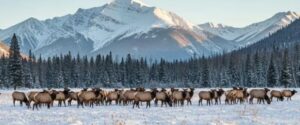
Elk near Longs Peak, CO
Colorado’s 19 hatcheries produce 90 million fish annually for sport-fishing and native-species recovery.[i] The Colorado Wildlife Habitat Program has conserved over 300,000 acres and nearly 400 miles of rivers and streams.[ii] The Ranching for Wildlife program is a CPW partnership with large private ranches (over 10,000 contiguous acres) to provide public hunting access, improve wildlife habitat, and support coordinated wildlife management. It began in 1986 and now includes 25 enrolled ranches, which together offer about 1 million acres of public access and thousands of limited-license hunting opportunities annually.[iii] Since 1997, the Colorado Wetlands Program has spent nearly $40 million on wetland and riparian preservation in Colorado. Over those 3 decades, the program has preserved, restored, enhanced or created almost 220,000 acres of wetlands and adjacent habitat. Wetlands habitat is estimated to benefit more than 75% of all species in the State.[iv]
Several places in Colorado are highlighted as “watchable wildlife” areas, such as Windy Gap, Love Meadow, and Waunita (a prime spot for viewing Gunnison Sage Grouse).[v] Colorado also must respond to numerous threats from non-native invasive species, including aquatic nuisances such as zebra mussels, quagga mussels, rusty crayfish, and Asian carp. Forest pests like pine and spruce beetles threaten millions of trees, and noxious weeds pose a major threat to native plants, forests, and farms.[vi] The state also actively promotes wildlife photography, a significant factor in Colorado’s tourism economy. The CPW Commission is considering a citizen petition to require photographers to purchase permits, though no such requirement now exists. The petitioner argues that wildlife photographers profit from a publicly managed resource without contributing financially to its conservation, unlike hunters and anglers who pay license fees.[vii] That is the essential point of this section, namely, that hunters and anglers finance nearly all of Colorado’s wildlife conservation infrastructure and administration.
Enforcing hunting and fishing laws, administering licenses and permits, improving habitat, restoring wetlands, managing invasive species, promoting photography, maintaining public facilities at wildlife areas, ensuring public access – these examples barely scratch the surface of wildlife conservation activities, and they are virtually all funded almost entirely through hunting and fishing revenue.
What Risks Might Be Ahead for Hunting and Fishing in Colorado?
The importance of maintaining (or expanding) hunter and angler numbers goes far beyond protecting the outdoor heritage of Colorado. Hunters and anglers still provide the lion’s share of funding for fish and wildlife management in Colorado.[2] The promising trend for angler participation is important but not sufficient, by itself, to fund wildlife conservation in Colorado. The sale of fishing licenses in Colorado results in roughly $25M in revenue, but operating the state’s 19 fish hatcheries costs $18M alone.[viii]
Notwithstanding this fact, an increasing number of citizen petitions for rulemakings and citizen ballot initiatives indicates that non-sportsmen and women want to have an increased say in how fish and wildlife populations are managed in Colorado. Many of these petitions for rulemakings and ballot initiatives focus on methods of take and individual animal welfare concerns rather than overall health of wildlife populations.
This trend follows a national effort by animal welfare activists to limit existing opportunities that they deem inhumane or unsportsmanlike. The bear and trapping initiatives from the 1990’s are examples of this approach. While there is no evidence that spring bear hunting with dogs and bait, or the trapping of predators, had adverse impacts on the overall populations of either bear or predators, the public voted to eliminate spring bear hunting and the use of dogs and bait and to prohibit leg hold traps with very narrow exceptions. Many additional citizen initiatives have been proposed with limited success.
These animal welfare activists have recently pivoted to citizen petitions for rulemaking to restrict bag limits on various species. This pivot reflects a strategic decision by these advocates to take advantage of a reconstituted Colorado Parks and Wildlife Commission (Commission) that is far more likely to be receptive to their proposals than historically has been the case. This approach is cheaper than citizen initiatives and doesn’t require signature gathering or expensive media campaigns to succeed at the ballot box. The recent decision by the Commission to reduce furbearer bag limits from unlimited to two per species is an example of this approach.
Even the definition of “science” is being challenged. CPW biologists have decades of harvest data gathered through voluntary surveys of hunters and anglers (including creel surveys) and mandatory check-ins for some species. Animal welfare advocates have challenged this approach and assert that “CPW lacks accurate overall population estimates” and challenge the methodology currently used to measure trends in specific species’ overall population health.
This attempt to reframe what is and is not responsible “science” presents a fundamental challenge to the way CPW has managed wildlife populations for decades. Many species are virtually impossible to count. Bobcats and bears are notoriously reclusive and do not lend themselves to herd counts the way deer, elk and pronghorn do. And even with these herding animals, winter counts which form the basis for overall population estimates use extensive extrapolation modeling to achieve the best available estimates for herd populations.
While this might seem somewhat academic, animal welfare advocates attempt to challenge CPW’s science and shift the burden to biologists to “prove” that the overall health of a given species is capable of absorbing the annual harvest of hunters. These challenges are generally not applicable to fishing for many reasons, not the least of which is that the majority of fish in Colorado’s rivers and lakes are present (either directly or indirectly) because of CPW’s extensive hatchery and fish stocking program.
All of this is occurring within extremely challenging demographic and societal shifts both within Colorado and nationwide. As touched upon earlier, the rapid urbanization within the state results in people living in parts of the state where the simple logistics of getting to places where they can hunt and fish is harder. Urban fishing access is much easier and probably, at least partly, responsible for the three-fold advantage anglers have over hunters in the state.
Any parent can tell you that our youth are overscheduled with activities, and free time is at a premium. Whether it is soccer or band, youth sports and other activities take up far more time than the same activities did 30 years ago. This makes finding time (and money) for hunting and fishing much more difficult than for previous generations. Single parent homes and living in the age of electronics only exacerbate the challenges.
Cost and complexity for both hunting and angling are significant barriers to entry into these activities. Those raised in hunting and fishing families learn by tagging along with parents, often before they are old enough to participate themselves.
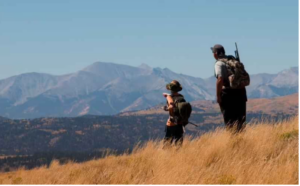
Exposure to hunting and fishing from an early age makes it far more likely that these youth will pick up a shotgun or fly rod than those who simply have never been exposed to these activities. Replicating the mentor/apprentice model eases newcomers through some of the seemingly endless challenges that can overcome novices without a family or non-family mentor.
What Opportunities Lie Ahead for Hunting and Fishing in Colorado?
As discussed above, the land and water available for hunters and anglers is decreasing overall. But many incredible opportunities exist for residents and non-residents to have world class hunting and angling opportunities. (See previous CSI report on public land and water access in Colorado). While some of these opportunities may have been free or low cost, they now may require access fees. Hunting and angling will continue to change, but keeping net hunting and angling numbers relatively stable is more than possible.
It is reasonable to assume that families with a history of hunting and angling will continue to pass on this heritage to future generations ensuring a core of sportsmen and women who will continue to be the primary source for conservation in Colorado. Additionally, Colorado will continue to draw residents and non-residents to our outdoors to pursue elk. This is critical because in many ways it insulates the state’s wildlife revenue. Colorado’s elk herd is the largest in the United States and it is hard to see demand for elk hunting declining within our lifetimes. Non-residents’ ability to hunt every year in Colorado is unique and critical for CPW revenue in the decades ahead.
Another potential bright spot is the “locavore” movement which emphasizes acquiring healthy protein close to home in an environmentally sustainable manner. This dynamic is drawing in “non-traditional” hunters and anglers who might not otherwise be inclined to participate. The potential to expand recruitment in vastly underrepresented demographics also presents an opportunity to maintain hunter and angler numbers.
Women, minorities and urban dwellers within the state provide a virtually untapped population of new hunters and anglers. The United States Fish and Wildlife Service estimates that only 11 percent of hunters are women and 97 percent of hunters are white.[ix] Programs to reach out and recruit from under-represented populations are ongoing and seeing some success.[x]
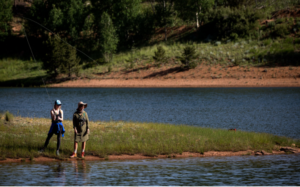
Again, with shrinking available access, the realistic goal should be to maintain net participation rather than worrying about trying to dramatically increase the overall numbers of hunters and anglers. An approach that recognizes and values the evolution of hunting and fishing is key. Hunters and anglers who are established and willing to pay for access can and will succeed as long as a reasonable number of novice sportsmen and women are recruited. Novices are much more likely to begin hunting and fishing in lower or no cost scenarios.
Interaction Between Lawmakers, Politics, and Hunting and Fishing
It could easily be said that politics and wildlife management have an uncomfortable relationship. Many conservationists believe simply that politics has no place in management decisions that are properly based on biology and other science. Yet under the Constitution, the legislature and Governor obviously have legal authority to make laws for the state, including management of its wildlife. The nature of that authority, entrusted as it is by the public, assumes a broad understanding by lawmakers of the subject matter, which is not always clear. More to the point, the people of Colorado have always held very strong opinions about the great outdoors, including everything related to conservation, the environment, and recreation. It is unrealistic to expect the general public, or their elected and appointed representatives, to stay out of the decision-making process when it comes to wildlife.
As a result, a number of processes have been designed to facilitate public involvement, and people can feel wronged when those processes are not followed, or when political pressures seek to sidestep, bypass, or thwart those processes. It happens frequently, especially when the statutory body charged with making hunting and fishing rules, the Parks and Wildlife Commission, is bypassed by direct attempts to change policy through legislation, ballot initiatives, or lawsuits. Colorado has experienced all three numerous times in recent years.
Two especially high-profile examples have created ongoing controversy for years: the ballot initiatives that banned spring bear hunting in 1992, and required gray wolf introduction in 2020. Both measures passed, and led to significant conflicts. The measure banning bear hunting between March and September has resulted in roughly doubling the number of black bears in the state, from an estimated 8,000-12,000 in 1992 to an estimated 17,000-20,000 today. The number of human-bear conflicts tracked by CPW increased about 4% annually in the decade after the initiative, roughly twice as fast as the state’s population.[xi] And the wolf controversy still rages across the state today, partly because over half of the 25 translocated wolves have already died, and partly because the remaining animals and their offspring have killed 20 head of cattle, 45 calves, 21 lambs, 33 sheep, and 2 dogs. (CPW figures as of 10/15/2026). There remains widespread disagreement among Coloradans about the wisdom of both ballot measures, and it is not this report’s purpose to judge the voters’ wisdom. But both are cases where the decisions were taken out of the hands of the statutory body in charge of wildlife management and based on political pressures instead.
Not all such ballot initiatives get past voters. A 2024 measure sought to prohibit bobcat, lynx, and mountain lion hunting, and would have imposed criminal penalties. It was rejected by a substantial margin (54.7-45.3%). An attempt was made in 2026 to place a measure on the ballot to cancel the wolf reintroduction program, and in 2020 a measure to ban trapping, but both failed to gain the necessary signatures.
There are also frequent attempts in the legislature to change hunting and fishing rules, with varying degrees of success. For example, a House bill in 2025 would have changed the statutory language governing wildlife management. Existing law identifies hunting, trapping, and fishing as primary methods of wildlife management. HB25-1258 would have eliminated that language and substituted “use of the best available wildlife and ecological science” in CPW Commission decisions. The bill failed in committee but prompted a lengthy debate over whether hunting, trapping, and fishing are, in fact, scientific methods of controlling wildlife populations.
A House bill in 2021 would have statutorily designated specific lands where the CPW could and could not reintroduce gray wolves, not based on habitat criteria but on whether voters in those areas had supported the initiative. Another bill the same year dictated that the wolf program could not be financed through license fee revenue and yet another created a defined process for public input on the program. Both became law, as did a 2023 bill creating a pilot program to reduce the use of lead bullets. But a bill prohibiting wolf reintroduction unless the federal government granted nonessential experimental population status was passed but vetoed.
A 2021 Senate bill sought to change CPW Commission policy by prohibiting allocating more than one-third of limited big-game hunting licenses to nonresidents, and another in 2022 sought to prohibit lion hunting. Both failed in committee, but stirred up significant debate, and the latter resulted in the ballot measure already mentioned. The same year, several legislators tried to pass a bill allowing non-hunters and non-anglers to access state wildlife areas without a license, apparently unaware the CPW Commission had already adopted such a policy the previous year. The CPW action itself was the result of a lawsuit challenging the earlier policy.[xii]
There are also lawsuits filed regularly that attempt to change wildlife policy. In 2023, the Colorado Conservation Alliance and other plaintiffs filed a federal lawsuit against the U.S. Fish and Wildlife Service and CPW, challenging the wolf reintroduction program as a violation of the federal Administrative Procedure Act.[xiii] The next year, the Safari Club International and the Sportsmen’s Alliance Foundation sued two sitting CPW commissioners after they co-authored an op-ed piece supporting Proposition 127, the proposed ban on mountain lion hunting. That suit alleged violations of Colorado’s Open Meetings Law.[xiv]
In another case, still on appeal, Friends of Animals sued CPW over regulations that restricted hiking, boating, dog walking, and horseback riding in State Wildlife Areas while allowing exceptions for some hunting and fishing activities.[xv] Finally, Colorado Advocates for Public Safety v. Stolzmann was a dispute over whether Boulder County had the authority to ban firearms hunting on federal lands.[xvi] There are literally dozens of other examples of lawsuits aimed at altering public policies related to hunting and fishing.
It is safe to conclude that for many years, there have been legislative proposals, ballot initiatives, lawsuits, and other actions by public officials and advocacy organizations that sought to change, influence, or overturn Colorado’s hunting, fishing, and wildlife-management policies. There are many examples on different sides of many contested issues. These examples illustrate that State officials charged with wildlife management are constantly under pressure from all sides to change their decisions, and often to decide such matters based on legal and political pressure. It is ironic, since wildlife advocates almost across the board argue for more scientific – and less political – bases for management decisions. It is an idea still in search of the ideal.
The Importance of Hunting and Fishing to Rural Colorado
The economic contributions of hunting and fishing are disproportionately important to Colorado’s rural communities and small towns. A 2017 study of the economic contributions of outdoor recreation in Colorado illustrates that phenomenon. According to its regional estimates, approximately 75.5% of the combined economic output associated with hunting and fishing occurred outside the Metro region, across the state’s six other regions (Northwest, North Central, Northeast, Southeast, South Central, and Southwest), which encompass Colorado’s rural communities. This geographic distribution underscores the importance of hunting and fishing as sources of economic activity outside the Denver/Colorado Springs metro areas, supporting local businesses, jobs, wages, and tax revenues in communities where economies are less diversified.
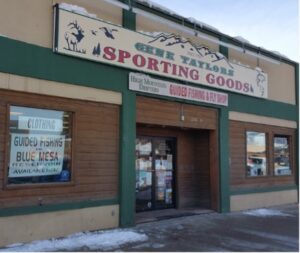
Local small business in Gunnison, CO
For example, economic output from hunting and fishing in the two regions of the Western Slope totaled $550 million, while the combined impact in the North and South Central regions was $1.36 billion – nearly $700 million more than that in the Denver metro area. Although the regional figures cannot be interpreted as an exact measure of economic activity in individual regions (because many hunters and anglers spend money in more than one region on the same trip), they demonstrate that hunting and fishing generate a substantial share of their economic benefits outside the Front Range metropolitan areas. Thus, those benefits can be especially consequential to local economies across the state, and most particularly in small towns and rural counties.[xvii]
For many such communities and counties, hunting and fishing represent far more than recreational opportunities. They are essential to the history, culture, and way of life, but especially to the economy. Hunters and anglers support the state through taxes on their licenses and supplies, as noted earlier. They also support hundreds of local businesses, sustain jobs, and contribute to the livelihoods of families whose economic opportunities may be more limited by geography, population, and the seasonal nature of tourism.
Hunters and anglers are customers for rural businesses. Beyond licenses, participants buy gasoline, groceries, meals, lodging, equipment, clothing, ammunition, bait, and innumerable other supplies. Many also hire guides and outfitters, rent ATVs, boats and other equipment, and purchase services from local businesses. These expenditures benefit a broad network of businesses, including gas stations, auto repair shops, motels, RV parks, restaurants, grocery stores, sporting-goods retailers, and independent service providers. Many of these businesses are small, locally owned enterprises whose revenues circulate repeatedly throughout the community.
Those economic benefits extend well beyond initial purchases, because local employees and businesses subsequently spend the income those purchases generate. In fact, money spent by hunters and anglers provides income for local employees as well, who in turn spend money on housing, food, vehicles, utilities, and other goods and services. Businesses also purchase supplies, pay local contractors, and employ area residents. Economists measure this ripple effect using regional economic multipliers. In one illustrative example, the Oklahoma State University Cooperative Extension Service found a multiplier of 1.5, meaning that each dollar of initial spending generated an estimated $1.50 in total economic activity in the same community, not counting its impact elsewhere across the state.[xviii] This circulation of spending creates economic benefits far beyond the original transaction, helping support other businesses and households throughout Colorado. But it is especially important in rural communities.
Rural communities do not always have the population base to support a large or diverse retail economy. Some are mostly dependent on agriculture, others on energy production, and some on hunting and fishing. In these communities, visitors drawn to hunting and fishing opportunities in the area provide an important customer base for businesses that might otherwise struggle to sustain themselves. Some businesses are predominantly seasonal. Ski areas are the most visible example, but communities in the heart of hunting and fishing “hot spots” can be just as seasonal, making this economic impact crucial to their survival. A motel room occupied by a hunter, a restaurant meal purchased by an angler, or fuel bought before a day on the water represents revenue that is particularly valuable to such dependent small-town businesses.
Seasonality makes these activities especially valuable but also makes these communities especially vulnerable to any changes in the hunting and fishing economy. Hunting seasons and fishing trips bring customers to communities at particular times of the year, helping businesses generate revenue outside the usual tourism periods. For some communities, the fall may be “mud season” when things slow down, but for others it is the heart of hunting season, which may bring a substantial portion of their annual income. These customers help justify remaining open during the otherwise slow period, retaining employees, or investing in equipment and facilities. That may ensure survival for family-owned businesses whose success helps determine whether the family can remain in the community and whether the next generation has an opportunity to continue.
The outsized importance to rural areas of these economic relationships is not always apparent in statewide totals. Economic-impact studies can estimate expenditures, jobs, and business activity, but local business owners can better explain what those numbers mean in practice: whether customers fill otherwise empty rooms, whether a hunting season adds to the annual revenue, whether a fishing guide supports a family, or whether a small business remains profitable.
The experiences and stories of rural business owners and community members provide an essential complement to understanding economic statistics. Their accounts help demonstrate how hunting and fishing contribute not only to Colorado’s overall economy, but especially to the economic resilience of rural communities that are central to the state’s character.
What Do Hunting and Fishing Mean to the People and Places That Depend on Them?
Statewide figures show where hunting and fishing dollars land. The people who earn them show what those dollars mean, and what happens when they stop coming. CSI interviewed outfitters, landowners, and community leaders from North Park to the Eastern Plains to understand how the trends in this report play out on the ground. Their message is consistent: when any part of the system that funds Colorado’s wildlife weakens, rural Colorado absorbs the loss first.
For many rural families and towns, hunting season does not just supplement the economy; it is the economy. Jenny Burbey, owner of Highlands Unlimited near Durango and president of the Colorado Outfitters Association, has built her family’s livelihood on hunting. “Since 1988, almost 80 percent, sometimes some years more, of my income was derived during hunting season,” she said. “It fed and clothed our children. It took care of multiple employees along the way.” In 2025 she sold her Forest Service permit and now runs hunts on private leases, reflecting the broader move toward private access described earlier.
The seasonality described above is not abstract for these towns. “Walden is 50 years behind everybody else, so it’s still a frontier,” said Matt Shuler, owner and editor of the Jackson County Star.
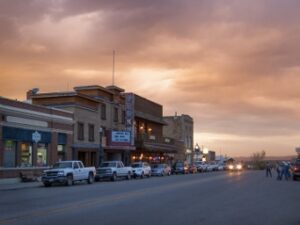
Walden, CO
There, he said, “most businesses make their money between August and December.” On the Eastern Plains, Bruce Rosenbach, dryland farmer and president of the High Plains Land Conservancy, described pheasant season in Holyoke the same way: “Our town depends on hunting season. Everyone is happy. People flood in, the restaurants are busy, and it is well worth the effort.”
That dependence leaves these communities acutely exposed to policy, especially policy affecting nonresident hunters. “95 percent of our clients are nonresidents. That’s just what it is,” Burbey said. “When there is something that brings down the level of available tags for nonresidents, that directly comes into our household.” Outfitting, she noted, is “a high overhead, low profit business,” leaving little room to absorb lost clients. Shuler described what happened in Walden after CPW raised nonresident license prices. In his account, the agency sold fewer licenses at higher prices and held its revenue steady, but the hunters stopped coming. “If they didn’t come, they didn’t bring their pickup to buy fuel. They didn’t go to the restaurant. They didn’t go to bars.” CPW’s license revenue may remain flat or slightly increase when prices for tags are raised and the number of tags available is reduced, but the resulting loss of consumer spending and reduction in economic activity result in a net loss for rural communities and the state.
For example, Colorado’s 80% increase in nonresident elk license prices in 2001 coincided with a 19.3% decline in total elk hunters and a 37.1% decline in nonresident elk license sales from 2000 to 2001. Meanwhile, total hunting and fishing license revenue grew by just 6.7%, from $55.1 million in FY2000–01 to $58.8 million in FY2001–02. With roughly 43,500 fewer nonresident elk licenses sold as a result of that decline, just $85 in lost trip spending per license would have been enough to offset the agency’s $3.7 million increase in license revenue.
When changing license fees or other policies affecting nonresident participation, policymakers should carefully consider the potential loss of spending at rural businesses.
Politics has compounded the problem. Burbey said wolves have not directly affected her business, but the politics surrounding wildlife in Colorado have made nonresidents wary of the state altogether. “They’re laughing at Colorado, and they’re going, well, I don’t want to give them my money.” Their experience suggests that the nonresident demand discussed earlier is durable but not guaranteed.
What those hunters leave behind is visible on the landscape. Since 1991, Rosenbach has worked with Pheasants Forever and CPW to plant windbreaks, winter cover, and pollinator habitat across Phillips County, much of it now open to the public through Corners for Conservation and walk-in hunting access. “You can’t measure the difference it makes. It’s changed our county,” he said. “It is the hunters’ dollars that opened the door and gave us these programs, conserving and protecting habitats and farmers’ crops, and benefiting farmers at the same time.” Shuler made a similar point about North Park, where wildlife and ranching share the same ground. “The private land in the West is where the animals live, but it’s also where the agriculture gets done.” Hunters pay whether or not they succeed. Burbey calculated that clients of her business who went home without an animal in 2024 still paid about $72,000 in license fees. “They went home with tag soup on those licenses, so I consider that a direct contribution,” she said. Anglers contribute beyond their licenses as well. Greg Felt, co-owner of ArkAnglers in Salida and Buena Vista, said many of his clients belong to groups like Trout Unlimited and stay deeply engaged on water and wildfire issues, which Felt called “major risks” to Colorado’s streams and fisheries.
Sustaining that contribution depends on the next generation, and the interviews echo the participation trends described earlier. Felt has watched fly fishing broaden to draw more women and younger anglers, helped along by COVID and online learning. He sees the outdoors as something people lean on when life is hardest. “When times get tough, people need it even more.” Burbey sees gains among women hunters but warns that the sport’s core is shrinking. “The people that hunted and carried it for a long time have aged out, and they haven’t been replaced yet,” she said. She faults recruitment efforts for reaching kids without reaching their families. “We didn’t market it to the whole family. We marketed it to seventh graders. That’s good for getting those seeds planted, but they can’t drive, and if their parents aren’t doing it, they don’t get [to go].” Felt pointed to the family culture that sustains hunting, and to a stereotype that obscures it. Rather than trophy hunters, he said, “most people I know are meat hunters.”
The barriers facing newcomers are real. Shuler noted that fewer young people grow up with hunter education or FFA, and that CPW’s big game brochure now runs 84 pages with separate rules for each unit, enough to confuse him after 40 years of hunting the same ground. Cost weighs just as heavily. “How much time people get to devote to things like hunting and fishing when they’re having a difficult time actually paying rent… is a much harder thing now than what it was when I was 21,” Burbey said.
The deepest concern across the interviews was how wildlife decisions are being made. Burbey said policymakers treat hunting and angling as “a bottomless economic pit,” and that the Commission leaves budget questions to staff. “I think that that’s a disservice,” she said. Felt said policymakers “often fail to recognize hunting and fishing as a renewable resource.” Because participants depend on a healthy environment, the activities draw them into conservation and back to the license dollars that fund it.
Felt has also watched CPW drift from its traditional reliance on science and biology over the past eight years, and Shuler said the Commission is sidelining the agency’s own biologists, whom he counts among the best anywhere. These views mirror the challenges to CPW’s science outlined earlier. Burbey pointed to the wolf campaign as a missed opportunity for the agency to lead with its own findings. “The agency should’ve been at the forefront with their habitat [data]. This is what we found, and this is why we have not pursued reintroduction.”
These voices also point toward solutions. Rosenbach’s advice is simple: “Keep these programs running. Stick with it. There’s no limit to these conservation programs, and the hunters are big drivers.” He added that farmers and landowners should keep deciding what’s best for their land. Voluntary programs that pay landowners and open private land to the public, a family culture of hunting and fishing, and stable access for nonresident hunters each strengthen the cycle that funds Colorado’s wildlife and the towns that depend on it.
Hunting and fishing are not just a niche pastime in rural Colorado. They are a paycheck, food at the dinner table, a habitat program, and a main street that stays open through the seasons. Every decision that raises costs, limits access, or sidelines CPW’s science reaches these communities first. Keeping hunters and anglers in the field keeps Colorado’s wildlife funded and its small towns viable.
Conclusion
Hunting and fishing are not “merely” recreational activities in Colorado. Hunting and fishing are the backbone of all game and non-game conservation in the State. Protecting the heritage, the revenue and the economic stimulus that are derived from these activities is critical to ensuring that Colorado’s fish and wildlife stay vibrant for decades to come.
Hunting and fishing license revenue (and matching funds from Pittman-Robertson and Dingell-Johnson) fund fish and wildlife management in Colorado. These funds, when combined with Great Outdoors Colorado revenue, fund conservation easements and other habitat protection programs that ensure open spaces and wildlife habitat will always be part of the Colorado landscape.
Colorado’s economy (especially its rural economy) desperately needs the money spent by hunters and anglers. Expenditures by sportsmen and women provide a critical infusion of cash into local economies and extend the business season well beyond the normal busy summer season.
Colorado can boast some remarkable successes in managing wildlife derived from the activity itself and the funding generated by hunting and fishing. The successful reintroduction of river otter, Canada lynx, moose, black-footed ferret and many native fish populations would not have been possible without hunting and fishing revenue.
Although shifting demographics and other societal changes will make maintaining hunter and angler participation levels difficult, there are many reasons to be hopeful for the future of both activities and the continued management of fish and wildlife as the beneficiaries of both activities. Ensuring the continuation of hunting and fishing in Colorado is foundational to this worthy legacy and future.
—
[1] See this report: Wildlife for All, “The Decline of Hunting and Fishing.” https://wildlifeforall.us/resources/decline-of-hunting-and-fishing-development/.
[2] The economic impact provided by hunting and fishing can be found in CSI’s prior report here: https://commonsenseinstituteus.org/research/the-economic-impact-of-hunting-and-fishing-and-its-connection-to-amendment-83-the-first-in-a-two-part-series/
[i] Colorado Parks and Wildlife, “Fish Hatcheries,” https://cpw.state.co.us/fish-hatcheries.
[ii] Colorado Parks and Wildlife, “Colorado Wildlife Habitat Program,” https://cpw.state.co.us/colorado-wildlife-habitat-program.
[iii] Colorado Parks and Wildlife, “Ranching for Wildlife,” https://cpw.state.co.us/hunting/ranching-for-wildlife.
[iv] Colorado Parks and Wildlife, “Wetlands in Colorado,” https://cpw.state.co.us/wetlands.
[v] Colorado Parks and Wildlife, “Nature Viewing,” https://cpw.state.co.us/activities/nature-viewing.
[vi] Colorado Parks and Wildlife, “Invasive Wildlife,” https://cpw.state.co.us/invasive-wildlife.
[vii] Katherine Payne, “Wildlife Photographer/Artist Permit,” ASMP Colorado, American Society of Media Photographers, August 21, 2026, https://www.asmp.org/colorado/wildlife-photographer-artist-permit/.
[viii] Ali Longwell, “Where Does Colorado Parks and Wildlife’s Revenue Come From?,” Summit Daily, December 20, 2025, https://www.summitdaily.com/news/colorado-parks-wildlife-revenue-legislators-wolves/.
[ix] U.S. Department of the Interior, U.S. Fish and Wildlife Service, and U.S. Department of Commerce, U.S. Census Bureau, 2016 National Survey of Fishing, Hunting, and Wildlife-Associated Recreation, FHW/16-NAT(RV) (Washington, DC, revised October 2018), https://www.census.gov/content/dam/Census/library/publications/2018/demo/fhw16-nat.pdf.
[x] The Rise of Women Hunting in Colorado | Theodore Roosevelt Conservation Partnership
[xi] 16ag_bear_report-12-30-15-r2_1.pdf
[xii] Friends of Animals v. Colorado Parks & Wildlife Commission, No. 2020CV32680 (Colo. Dist. Ct., City & County of Denver).
[xiii] Colorado Conservation Alliance v. U.S. Fish & Wildlife Service, No. 1:23-cv-03294-RMR (D. Colo. Oct. 10, 2024).
[xiv] Safari Club International v. Colorado Parks & Wildlife Commission, complaint (Colo. Dist. Ct., City & County of Denver, filed Nov. 21, 2024).
[xv] Friends of Animals v. Colorado Parks & Wildlife Commission, No. 2023CV32544 (Colo. Dist. Ct., City & County of Denver), appeal docketed, No. 2025CA2144 (Colo. App.).
[xvi] Colorado Advocates for Public Safety v. Stolzmann, No. 24CA1673 (Colo. App. July 17, 2025) (unpublished).
[xvii] Southwick Associates, “The 2017 Economic Contributions of Outdoor Recreation in Colorado: A regional and county-level analysis,” prepared for Colorado Parks & Wildlife, July 23, 2018, https://oedit.colorado.gov/sites/coedit/files/EconomicContributionsOfOutdoorRecreationinColoradoStudy_2017.pdf
[xviii] Economic Impact of Conservation Dollars in Oklahoma | Oklahoma State University
RECENT/RELATED RESEARCH
What Colorado’s Health Plans Cover: Medicaid and Private Insurance

What Colorado’s Health Plans Cover: Medicaid and Private Insurance Key Findings Of 88 medical service categories identified by CSI, Health…
The Future of Hunting and Fishing in Colorado: What It Means for Rural Communities and Conservation
The Future of Hunting and Fishing in Colorado: What It Means for Rural Communities and Conservation Introduction Colorado voters will…
Colorado Labor Market Update – September 2026
Colorado Labor Market Update – September 2026 Summary: Colorado gained 2,400 nonfarm jobs in September, reversing a loss of 300…
Breast Cancer Awareness Month: Colorado Spotlight

Breast Cancer Awareness Month: Colorado Spotlight Introduction About one in eight American women, and roughly one in 755 men, will…