




December 16, 2025
Introduction
Colorado’s ongoing debate about public access to rivers and streams that cross private land requires a great deal of context. The first report in this series laid the groundwork for a more informed discussion by examining the current state of affairs – what the law is, how and why it evolved, the legal cases central to that history, and the lack of available data that too often fuels this debate. This report seeks to address another important aspect of that debate, the difference between public and private land and stream ownership. Some advocates for policy changes believe public ownership would provide better stewardship of these precious resources, presumably based on a belief that private landowners do not steward the lands as carefully. Others say landowners care deeply about these resources and invest more to improve the riparian environments than any public agency ever could.
This report’s research reveals that, in fact, landowners have invested – and continue to invest – hundreds of millions of private dollars improving Colorado’s rivers and streams, often with direct public benefits that frequently include public access, but in virtually all cases improve habitat and water quality for miles beyond their own property boundaries. Many of their projects are partnerships often involving NGOs, local governments, neighbors, and government agencies. But in all cases, they involve extraordinary private investments of which the public is largely unaware. There is no database, because private landowners are not required to report to any government agency how much money they spend, improving how many miles of river, or with what results. It is a complicated story with many chapters.
Key Findings
- Private landowners are a major pillar of conservation efforts in Colorado. River restoration and upkeep work is frequently undertaken by private landowners and can cost between $300,000 and $400,000 per mile, with some projects approaching $1 million per mile.
- These investments are privately funded and usually go unreported, but they help repair and preserve Colorado’s natural environment, with benefits that extend miles downstream, far beyond individual property lines.
- Conservation easements deliver durable protection and strong returns. From 2016 to 2020, the Conservation Easement Tax Credit Program certified easements that permanently protected 288,000 acres and more than 4,100 miles of streams.
- Private conservation investment depends on secure property rights and managed access. Policies that allow unfettered public access to private land greatly weaken stewardship incentives, increase risk and liability, and would ultimately reduce private investment in environmental restoration and maintenance.
Breadth and Depth of Current Conservation Efforts in Colorado
In Colorado, like most western states, quality habitat for fish and wildlife is connected to both public and private waters and lands. High-country rivers and streams start on land owned and managed by the federal government, usually the United States Forest Service (USFS). As they flow from the high country, they cross both private and additional public lands owned by the National Park Service, Bureau of Land Management (BLM), Bureau of Reclamation, State Land Board, and Colorado Parks and Wildlife (CPW). Healthy lands and rivers are critical for both fish and wildlife. For wildlife, it means connectivity for migration corridors and healthy landscapes for critical winter range, which is often the limiting factor in determining carrying capacity for big game herds throughout the state. For rivers and streams, this critical, symbiotic relationship between public and private landowners is essential to maintaining healthy wildlife and aquatic habitat. The relationship is even more important for the State’s aquatic resources. Rivers and streams don’t recognize land ownership, and Colorado’s efforts to improve streams, rivers and wetlands are a tremendous success story. Whether through conservation easements, including those acquired by the state tax credit program, access easements, private investment or acquisition by Colorado’s state parks and wildlife agency, fish, wildlife, and those who enjoy and value the state’s outdoors all benefit from these individual and coordinated efforts.
The extent of these efforts is a great and ongoing success story, but not a story that is easy to tell because of the large number of funders and participants. Funding comes from a myriad of public sources, including Great Outdoors Colorado (GOCO), Colorado Parks and Wildlife (including dedicated funding through sportsmen’s Habitat Stamp program), as well as from game cash. Financial resources are also generated from multiple land and water trusts, and finally through massive expenditures from private landowners. The state tax credit program incentivizing private landowners to permanently protect their property plays a critical role in these efforts as well. Many of these efforts are focused on specific regions of the state like the Coalition for the Upper South Platte (CUSP) and entities dedicated to specific rivers like the Greenway Foundation for the South Platte through the Denver Metro Area. All of these efforts have resulted in the profound improvement of Colorado’s rivers, streams, and wetlands.

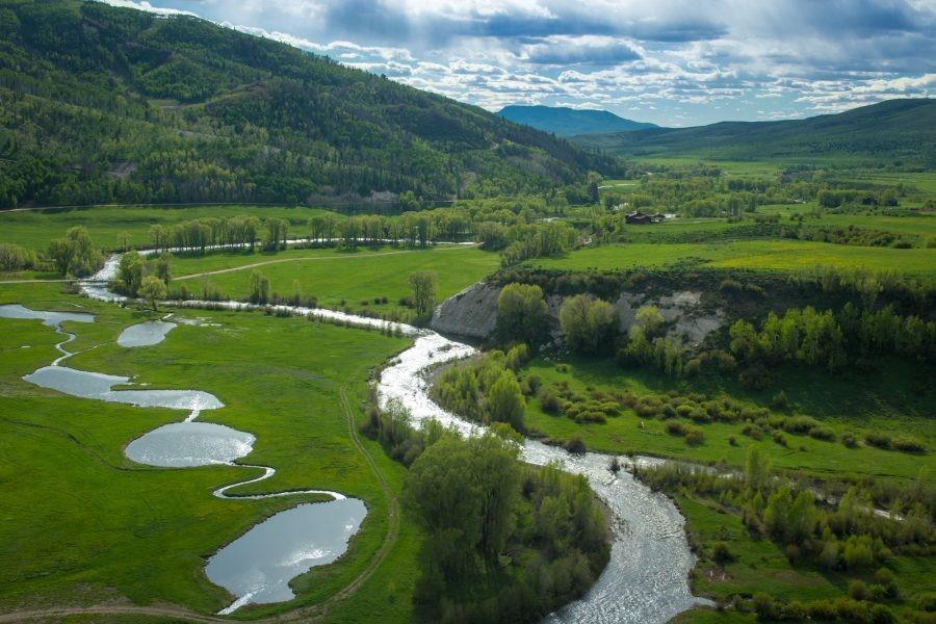
Photo of Colorado’s Upper South Platte
As was documented in the first CSI report on this topic, the relationship between public waters and private lands has evolved over the last 150 years. Specifically over the last 45 years since the Colorado Supreme Court case finding that the public does not have a right to touch river beds or banks, the “uneasy tension” has provided a path forward and resulted in collaboration on a number of fronts, not the least of which is incentivizing both the public and private investment in stream, river and wetland enhancement and conservation. The report below will provide details on how the investments and collaborations between public and private funding efforts have been critical to improving watershed health and recreation on both public and private land and resources. Investments on private stretches of river improve habitat and recreational opportunities on public waters both up and downstream. The inverse is also true. The efforts that are discussed below, which are occurring throughout the state, will be seriously undermined by any attempt to expand public access on private reaches of river. Private landowners’ investments will evaporate overnight without some assurance that their investments will not be overrun by unfettered public use.
Colorado as a Case Study
Coloradans and those across the country are often bombarded daily with stories of environmental challenges at the local, state, national, and international levels. It can be almost overwhelming to try to envision a path forward and a constructive mindset to address these innumerable challenges at every level. All of these challenges are interrelated and become even more complex and overwhelming when viewed together. Climate change impacts forest health. Forest health has a clear and direct impact on river health. River and stream health directly impacts water quality. Water quality impacts treatment costs for municipal water suppliers. The literal trickle-down effect in this one tangible example is replicated for air quality and virtually every current environmental challenge facing Colorado.
This case study of Colorado’s progress on water-quality challenges outlines a path, and further opportunities for improving the state’s environment. But the lessons can be replicated to address other environmental challenges. And that may be the most important lesson of all.
Who is Engaged to Address River and Stream Health in Colorado
Because rivers and streams do not respect jurisdictional or property boundaries, successful efforts to improve these habitats, likewise, require a comprehensive approach. In Colorado, river and stream health is being addressed by individuals, communities, local coalitions, the State of Colorado, nonprofits and the federal government. In Colorado, local governments are raising funds to improve river and stream health within their jurisdictions. The money raised is being used to match available fundraising from NGOs, state and federal resources. Nonprofits and land trusts are not only helping fund projects, but also doing the heavy lifting of planning, implementing and ensuring that the improvements are maintained in the impacted areas. And finally, private landowners are making astounding investments to improve river and stream health. None of this happens without comprehensive planning and a commitment to improve resources that do not acknowledge property boundaries. In any given basin, streams cross and recross public and private lands innumerable times as they march inevitably to the state line.
Local Efforts
One of the best examples in Colorado is Park County. Park County currently generates over $2 million annually for the Land and Water Trust Fund. The one percent sales tax has been in place for over two decades, and these funds are allocated annually to stream restoration and habitat improvements (as well as land conservation) within Park County. The stream, river and wetland money is dedicated to projects, often coordinated by Coalition for the Upper South Platte (CUSP) and implemented through various land trusts to leverage other available money to perform significant water quality and habitat improvement projects throughout Park County. Since 1998, Park County has invested over $12M in sales tax revenue and received matching funds in excess of $27M during that same time period. In addition to the habitat improvement for fish and wildlife, these projects dramatically improve the water quality for municipal water providers along the Front Range. Recognizing the value, Denver Water has invested tens of millions of dollars through their Forests to Faucets program in recognition of the benefits of having healthy watersheds in their collection area.
Nonprofits and Land Trusts Play a Critical Role
Many nonprofits and land trusts operate on a national level with active state offices. Examples include Ducks Unlimited and The Trust for Public Lands. Other NGOs are basin or even sub-basin specific. The Coalition for the Upper South Platte (CUSP) is an example of a local NGO performing critical work in a relatively small geographic area. CUSP works with Park, Clear Creek, Jefferson, Douglas and Teller Counties to identify critical needs for rivers and streams within the basin and leverages the funding, their relationships and expertise to make significant improvements to riparian habitat and watershed health throughout the basin. While funding projects is critical, equally critical is the support of the communities where the projects are proposed. CUSP describes their efforts as “collaborating with numerous parties, including local government, federal and state agencies, business and community organizations. This collaboration allows for a comprehensive approach to watershed management, addressing issues such as pollution sources, habitat restoration and recreational opportunities.” Cleaner water within the Upper South Platte improves water quality on the South Platte throughout the basin. Understanding how to tap into the various funding sources as well as build local support for projects is critical for CUSP’s success.
CUSP reports that it has invested over $30M in on the ground and planning projects in the upper South Platte since 2009. Almost all of this funding has a direct impact on water quality and recreation within the basin. CUSP operates in a geographical area that includes two of the most catastrophic wildfires in Colorado’s history. The Hayman and Buffalo Creek fires consumed almost 150,000 acres, all of it in the Denver Metro watershed. Of the $30M invested by CUSP, $20M has been spent on forestry and wildfire preparation and post-fire recovery. Additionally, over $8M has been invested in river and stream restoration, not including the massive investments by private owners in the watershed, as discussed below.
As an example of an “on-the-ground project” and the complexity and cost of such projects, the removal of the Lake George Diversion Dam included coordination between 10 public and private entities including five government agencies, a public utility and three NGOs. In total, the project required an investment of over $5M and was initiated in 2015 with monitoring and bank restoration efforts still ongoing. This type of collaborative effort is common for these types of projects and requires remarkable patience and persistence to complete.
Colorado Water Trust
Colorado is blessed with a remarkable consortium of nonprofits and land trusts committed to improving Colorado’s environment. The biggest players year in and year out are The Nature Conservancy, Colorado Cattlemen’s Agricultural Trust, National Fish and Wildlife Foundation (NFWF), Colorado Open Lands, and The Trust for Public Lands. Other entities play a critical role in basin or region-specific efforts. Virtually all of these national and statewide entities engage in far more than water-based conservation efforts. These entities perform every function including fundraising, finding matching funds, providing habitat evaluation and prioritization, on the ground collaboration with stakeholders and ultimately holding easements or contracts to ensure that habitat improvement and preservation efforts are secured for the long term.
 Photo from the Colorado Water Trust
NFWF, for example, has pursued an aggressive conservation strategy in the state called RESTORE Colorado. NFWF describes the program as pursuing “at-scale habitat restoration and stewardship projects on public and private conservation lands in Colorado that have the greatest benefit for wildlife and local communities.” They list among their partners the Colorado Department of Natural Resources, CWCB, the Gates Family Foundation, Occidental, Walton Family Foundation and United States Department of Agriculture Natural Resources Conservation Service. Their partners may be unique, but their approach to habitat protection and improvement is replicated by most of the NGOs and Land Trusts. In their 5-year report of 2020-2024, NFWF protected 5,400 acres of mesic habitat and 90 miles of instream habitat. During those five years, NFWF awarded (all projects) more than $16.5M and leveraged an additional $30.1M.
The Colorado Water Trust has used a market-based approach to protect and restore 814 miles on 27 rivers within the state since 2001. Similarly, Ducks Unlimited (DU) completed 14 projects on public and private lands in fiscal year 2024 and conserved almost 3400 acres of critical wetland and waterfowl habitat in Colorado. DU contributed $2.2M in 2024 to these projects and was able to match CPW funding on a 1.75:1 ratio. DU has invested almost $47M in Colorado since their inception.
State Funding
As with most of the entities providing resources to river and stream health in Colorado, trying to compile a comprehensive list of participants and resources is almost impossible. The examples below are almost assuredly incomplete, and efforts beyond those cited undoubtedly exist. Notwithstanding this challenge, the State of Colorado’s annual investments in river and stream health are impressive.
Legalized sports betting has resulted in a significant and ongoing infusion of money for the Colorado Water Conservation Board (CWCB) to invest in water project grants. In 2025 the CWCB provided $7.2M in grants to applicants for “planning, design, and implementation of watershed health and recreation projects.” These funds are awarded to project proponents across the state. These grants were doubled by matching funds from other public and private partners. In 2025 alone, CWCB grants preserved 779 acres of habitat and restored over 56 miles of streams and rivers throughout the state.
CPW’s Wetlands for Wildlife Program has participated in 252 wetland and riparian restoration projects over the past 10 years. It should be noted that this is only one of the conservation programs administered by CPW. CPW has invested over $11M in this period while leveraging over $18M in partnership investments in these projects. As importantly, the Wetlands for Wildlife Program has engaged at least 106 public/NGO partners and 123 private landowners to ensure the restoration/enhancement of over 35,000 acres statewide.

Photo from CPW Wetlands for Wildlife Program
Since its inception in 1992, Great Outdoors Colorado (GOCO) has protected over 1,100 miles of rivers and streams in Colorado with conservation easements. In 2024, GOCO worked with The Nature Conservancy to enhance the hydrology of the Yampa River to benefit endangered fish by reconstructing the headgate of the Maybell Ditch. This project restored water movement on 55 miles of stream and improved connectivity while at the same time addressing irrigation needs. GOCO contributed over $250,000 to the $6.8M project. These types of public/private partnerships are critical to addressing water challenges in Colorado.
In addition, the Colorado Conservation Easement Tax Credit Program has protected thousands of miles of rivers and streams in Colorado. The Land Trust Alliance estimated that Colorado landowners placed about 491,000 acres of land under conservation easements held by land trusts between 2015 and 2020.
A significant portion of these conservation easements were acquired through Colorado’s Conservation Easement Credit Program. This Program provides tax credits for landowners who place their property under permanent conservation easements, thus protecting wildlife habitat, rivers and streams and other open spaces from development. The Conservation Easement Tax Credit Program certified that 288,000 acres were protected through this program between 2016 and 2020. The Conservation Easement Tax Credit Program also permanently protected over 4,100 miles of streams, creeks and rivers. While these acres don’t involve cash payments, they effectively result in the state foregoing revenue that would otherwise be received. In 2018, the Program resulted in $23.9M in foregone revenue and between $14.6M and $30.1M per calendar year from 2016 to 2020 and $1.1B since the inception of the Program in 1995. Investment in these properties pays handsome dividends. A 2023 study by Colorado State University found that each dollar in foregone revenue conveyed between $4 and $12 in public benefits.
Colorado Parks and Wildlife (CPW) provides $1.5M annually to wetland and stream projects throughout Colorado. These funds are often leveraged with GOCO funds, to match federal and local funding further providing partnership resources to priority projects. CPW funds are provided through sportsmen’s contributions via Habitat Stamp and State Waterfowl Stamps. Projects are prioritized and spending authorized by the Parks and Wildlife Commission and appropriated by the legislature. In addition to the monetary contributions by CPW, staff biologists developed the Colorado Statewide Action Plan (SWAP) that establishes priorities for other entities to use in prioritizing projects across the state.
Federal Partnerships and Funding
State, local, and nonprofit efforts are supplemented by periodic infusions of federal money. The scope and amount is subject to annual appropriation and often vary from year to year. The USFS, BLM, and NRCS have staff dedicated to aquatic and riparian health, and these entities work closely with state agencies and NGOs to provide planning and prioritization assistance to these other entities.
In January 2025 Congress passed, and President Biden signed, legislation that would have provided $177M to water projects to address drought and river health in Colorado. Some of that funding has been held up by the current administration, but project proponents are hoping for the eventual release and investment of those funds.
The highest profile funding in the January 2025 bill provided $40M for the purchase of the Shoshone Hydroelectric water right. This pre-compact right is proposed to be purchased by a broad consortium of interests from across the state and converted into an instream flow right held by the CWCB to ensure that in the event that Xcel Energy decommissions Shoshone, the water that has generated power at the plant will remain in the Colorado River in perpetuity. Colorado’s Congressional delegation is working tirelessly to get these funds released and secure the massive environmental and economic benefits to the state.

Photo of Colorado’s Upper San Juan
Some of the other projects in the bill include $2.2M for the Upper San Juan to repair damage to the river caused by a landslide, including willow planting and rechannelization to improve aquatic ecosystems. The Upper Colorado River Ecosystem Enhancement Project in Grand County would provide $1.43M to restore two stream reaches on the Fraser River and Willow Creek. This money would facilitate work undertaken by the Learning By Doing Cooperative which has become a national model for community driven projects to restore degraded riparian ecosystems. The Boulder Creek Headwaters Resiliency Project, led by the Boulder County Watershed Collective, will receive $954,000 to restore 181 acres of degraded aquatic and riparian habitat as well as 2.8 miles of wet meadow streams throughout the Boulder Creek watershed. Some of this funding may eventually continue. For instance, $4M in funding from this bill was released in July to restore lands and streams in the Upper Colorado River Basin watershed around Grand Lake and Rocky Mountain National Park.
The Role of the Private Landowner
In 2019, when John Gunn and a couple of partners purchased the historic 510-acre Abell Ranch in Park County, they got some of the most valuable developable land in the middle of Colorado. Encompassing 3 miles of the South Platte River between 11-Mile Canyon and Cheesman Reservoir, the site is ideal for trophy homes. But they had no intention of developing it. They wanted to protect it, beginning with a conservation easement donated to the Palmer Land Conservancy, for the perpetual enjoyment of the surrounding community, people who visit the area, and the wildlife that depends on it. As Gunn told Keep It Colorado, “It would be an ideal place to put in several houses. The family could have sold it to a developer but chose not to.” The ranch is just below Lake George, where the river flows across the Abell Ranch, a couple other smaller properties, and Sportsmen’s Paradise at the confluence of Crystal Creek. The remainder is on Pike National Forest land all the way to Cheesman Reservoir. All 9 miles of that river stretch have been restored.

Photo of Abell Ranch in Park County
When Gunn and his partners began work on the river, the property had been overgrazed for decades, leaving the river too wide and shallow, and the banks badly eroded. There were about 20 fishing holes in those 3 miles, on which the new owners ultimately spent over $600,000. Today it is a world-class fishery. The grass and willows have returned, along with healthy populations of trout, and there are more than 50 fishing holes. In addition to permanently protected open space, the property also provides some of the region’s most popular habitat for elk, deer, black bear and mountain lion. Three types of restored or created wetlands also host great blue herons, bald eagles, white pelicans, snowy egrets, and the Pawnee montane skipper, a federally protected butterfly that exists only in Colorado’s Upper South Platte basin. And the river itself contains healthy populations of brown, rainbow, cutbow and cutthroat trout.
In 2025, such river restoration projects average more like $300,000-400,000 per mile – triple what it cost John Gunn and his partners several years ago – and some owners estimate a cost of $1 million per mile, depending on what needed to be done. Yet every year in Colorado, dozens of property owners spend such sums and more, restoring, building, and improving rivers and streams. Nor are these one-time expenditures. Like any other property, quality fisheries require regular maintenance. For example, whenever the flow on the Abell Ranch tops 700 cfs, it can wash out some of that restored habitat, requiring an ongoing expense to maintain the river. Gunn reports spending about $40,000 this year on restoration and says that is not unusual. Neighboring owners have similar ongoing maintenance costs.
As discussed previously, Park County itself also spends more than most counties on river restoration projects, dedicating revenue from the state’s habitat stamp program, grants from GOCO and local funds. Yet it never has enough money to fund more than a few projects each year. The restored fishery, and the resulting water quality, wildlife habitat, and other values depend largely on the investment of private landowners.
Stream Restoration
There may be a popular misconception that natural streams in Colorado provide pristine and perfect habitat, except when the actions of people alter the original environment, always for the worse. But in fact, hundreds of miles of streams in the state were historically intermittent, literally dry late in the year and flooding during the spring runoff. Such intermittent streams could only support fish and other wildlife, as well as recreation, intermittently until hundreds of water systems built in every major watershed provided the storage, flood control, and steady flows Coloradans enjoy today. In many cases, reservoirs, diversions, and irrigation structures provide flows of water and year-round habitat where there were none before. In other cases, these human activities, along with roads and other construction, have damaged the natural streams so that restoration is required to bring back habitat and recreational flows.
In both cases, the work of private landowners has been crucial to stream restoration projects throughout the state. Landowners have addressed both, creating quality fisheries where there were only mud flats, and restoring quality streams that were previously damaged. That requires more work than most casual observers imagine. It involves improving channel dynamics and water quality, stabilizing the streambanks, installing rock deflectors and sills, deepening stream channels, creating pools, plunge drops, deep holes, and adding woody debris, boulders, and other structures that enhance trout habitat. Fish barriers are often constructed to prevent non-native species from disrupting the trout’s lifecycles, and vehicle crossings are improved to reduce sediment entering the river.
All of those strategies and more have been implemented by landowners in every major basin in Colorado. The North and South Forks of the South Platte provide excellent examples of the restorations that are common statewide. One ranch, for example, which is adjacent to the Pike National Forest, has about 3 miles of the North Fork and a mile of Tyler Creek, and its neighbor has another 200 acres, which has been in the same family since the 1920s. The latter has a conservation easement through Mountain Area Land Trust and encompasses another 2 miles of the North Fork. Both ranches operate day-fishing opportunities on those 5 miles, and while they are still working ranches, make at least some of their income by selling access to anglers and floaters. The former ranch owner’s family has done well over $1 million worth of stream improvements since they bought the ranch in the 1980s, including significant additions of “cover” for the trout, meaning vegetation and rocks. They had to spend hundreds of thousands restoring the channel after dredging, channel clearing, and streambed alterations Denver Water had done following completion of the Roberts Tunnel a few miles upstream. Today the fishery depends at least partly on clean water made possible by the Roberts Tunnel but also requires regular maintenance. The owner says, “The amount of silt we pull out every year would destroy the stream for fish [if left alone].”
Note that fisheries can be enhanced by water projects like Dillon Reservoir, without which many streams might be dry or seasonal, as mentioned before, but reservoirs can also make nutrients settle and the water downstream, though clean, may not support fish because the water is too clear. Those waters also require active management, regular maintenance, and sometimes expensive restoration, as was the case on the North Fork.
Another property in that watershed is a historic ranch between Pine and Buffalo Creek, purchased by a partnership of a dozen owners in 1980. Several of the original partners are still there, still enjoying their mountain retreat and still investing heavily in its maintenance. It remains private, occupying about 1,200 acres on both sides of the state highway and encompassing 2 miles of the river, which is sometimes said to be the premier stretch of water for fishing on the North Fork. But the fact that the land is private belies the public benefit of their investment. In 2023, they began a riparian improvement project that ultimately cost well over $1 million. That included construction to realign the streambed, enhance the flows, add thousands of tons of rocks and boulders – over 100 truckloads – and improve over 1.5 miles of the stream.
The partnership put 2,500 trout in the river just this year, and an individual partner added hundreds more at his own expense. The irony is that half of the owners of that property are not even anglers (it remains primarily a working hay ranch) yet were willing to spend such sums improving the fishery anyway, because it seemed like the right thing to do. The result is not only far more and healthier fish, but a great deal of other wildlife, as well. Erosion control, improved water quality, reduced silting, and more natural flows (too rapid flows had been a problem ever since construction of the Roberts Tunnel) were tangential benefits. The property now hosts a nesting pair of bald eagles and frequent moose visits, none of which were there before the riparian improvements. The habitat was improved for many miles downstream of that ranch, as well, as commonly happens downstream from such private investments. The pride of ownership is important to these owners, and even the non-anglers share that pride. Like many other owners, they also cite the ongoing expense of maintaining the habitat, which they view as a permanent cost of the business. One of the partners is a real estate developer who says, “When I’m in Denver I am a developer but when I’m up here I’m a conservationist.”
A landowner in Eagle County, whose property is on Brush Creek between the Town of Eagle and Sylvan Lake State Park, has invested heavily in stream improvements. His work was entirely privately funded but has greatly enhanced not only the fishery on his own property, but also throughout that basin, and has improved water quality far downstream, including in the Town of Eagle and the confluence with the Eagle River.
Perhaps more private investment has gone toward improving the Blue River than any other river in the state. It has been widely reported that the 25,000-acre Blue Valley Ranch’s owner alone spent over $14 million improving the river, on which he allows public floating. Blue Valley Ranch’s mission statement and founding principles are all about stewardship. “The ranch strives to be a leader in conservation and a model for what integrated resource management can accomplish on private lands in the Western United States. The ranch’s legacy of land stewardship began with a conservation vision in 1994, and a focus on science-based, adaptive management principles has guided the ranch in building natural resource, wildlife, agriculture and recreation programs ever since.”
Earlier this year a land exchange with the Bureau of Land Management traded nine federal parcels in Grand County for nine private parcels, with a net public gain of 341 acres. Besides consolidating fragmented inholdings, the deal increased public access to the Blue River and its confluence with the Colorado, adding continuous public access to 1.6 more miles of river
at the mouth of Green Mountain Canyon and two contiguous miles on the Blue River at its confluence with the Colorado River. The land exchange agreement adds infrastructure like the Green Mountain Recreation Area with 1.6 miles of walk-in fishing access to gold medal water, hiking access to Green Mountain, two rest stops with picnic tables, and two new permanent take-outs for floaters. At the confluence of the two rivers, ¾ of a mile of degraded river will be restored and tie into 2 miles of public access to the Blue River. At this new recreation area will be wheelchair accessible fishing platforms, a new take-out, a picnic area, two miles of new trails, restrooms and parking. The BLM will own and manage the recreation areas. All of the improvements are privately funded, and an endowment held by the Foundation for America’s Public Lands will pay for the long-term maintenance of these amenities – funded by a private donation. The improvements serve to realize the benefits of consolidating land ownership. All of this is made possible through a cooperative agreement between a private landowner and the BLM.
Another Blue River ranch owner spent roughly $8 million on stream improvements upstream from the Blue Valley Ranch. One ranch manager in the area stated that there are three different properties whose owners have invested similarly in improving the Blue. Such construction projects, he says, routinely cost hundreds of thousands, often millions in recent years.
There are several investors in Colorado who own several different ranches and invest heavily in stream improvements in multiple locations. One owns at least 15 ranches totaling almost 19,000 acres in Douglas, Elbert, Grand, Jackson, Park, and Routt Counties. He has done many stream improvement projects on his properties in these areas, including at least one in partnership with the Colorado Water Conservation Board, which owns instream flow rights on Buffalo Creek two miles downstream from one of his ranches in Grand County.
Another raises a half-million fish annually in his own hatchery and maintains over 20 miles of streams in Colorado. In Park County that includes stretches of Tarryall Creek, the North and South Forks of the South Platte, 12-Mile Creek and Ten-Mile Creek. One stream is only 6 feet wide but now hosts 18-inch brown trout. In Grand County he has ranches on the Fraser River, Strawberry Creek, Muddy Creek, and the Colorado River. He has spent large sums restoring all but the Colorado River itself. There are brown trout spawning in Muddy Creek for the first time in decades, and it is one of only 3-4 places in the state where stickleback minnows (brook sticklebacks) are thriving. On one stretch of river, he restored about eight miles, including planting native willows and other riparian species, and the area now has a healthy beaver population that wasn’t there before. “There isn’t any money in this kind of work,” he admits. “I just like doing good work.”
That owner is a noted philanthropist and regular donor to numerous charities, and a strong supporter of Project Healing Waters (more on it below). He has conservation easements on 15 properties and regularly partners with both Trout Unlimited and Ducks Unlimited. He is committed to environmental improvement, but fears such projects are imperiled by unfettered public access. He has tried allowing public access in some places but in at least one case it resulted in drastic overfishing of the brown trout (he caught one fisherman taking several stringers at once in defiance of state limits), campfires left burning, and trash left behind. He says the fishery is delicate and cannot survive such abuse, so he prefers individual agreements with responsible recreationists. Such abuse is presumably committed only by a small minority, but without some control, it only takes a handful of bad actors to have a profound impact on the resources.
Other river restorations are private-public partnerships, such as the large and ongoing restoration of the Eagle River through Edwards. The Eagle River Watershed Council oversees one project funded by the Eagle Mine Natural Resource Damage Recovery Fund and by contributions from private landowners and local partners. Another $12 million project involved buying and restoring segments on the Eaton Ranch (now Eagle River Preserve), the Miller Ranch, and other parcels west of Edwards, half funded by the Vail Valley Foundation and other private donors, and the other half by Eagle County and GOCO. The Edwards Reach Habitat Project, carried out by the Watershed Council, was funded by Vail Resorts and other private partners. Other projects involved private owner investments, including the Cordillera Valley Club and several other HOAs that own private parcels on the Eagle River. The Eagle River Fund was launched by local landowners to provide long-term private grant funding for river projects throughout the Eagle River watershed, managed by the Eagle River Coalition. Several projects on the Riverwalk in Edwards are being financed through private donations through the Eagle River Fund, used to leverage the cost of erosion stabilization and aquatic-habitat improvements. The project is far larger than any individual property, though it could not be funded without the help of private landowners along the Eagle River.
Another example is the riparian restoration project on the Little Navajo River, a partnership between a local ranching family, the Chama Peak Land Alliance, and the Western Landowners Alliance. The 5,000-acre ranch is on the headwaters of the San Juan–Chama Project in Archuleta County, and its owners have worked to enhance the watershed’s health and the resilience of the forest. The Little Navajo River runs about 10 miles from the South San Juan Wilderness in Conejos County, into the Navajo River, a tributary of the San Juan. Much of its water is diverted across the Continental Divide to the Rio Grande basin as part of the San Juan–Chama Project, so the Little Navajo restoration project was designed partly to mitigate the loss of much of the natural flow while enhancing fish habitat. The project leveraged some funding from RESTORE Colorado (including GOCO funds) with primary support from the landowner. The restoration includes installing rock deflectors and sills, deepening stream channels, creating pools, and adding wood debris to enhance trout habitat, a fish barrier to exclude non-native species, and improved vehicle crossings to reduce sediment.
The primary aim is to restore and create the necessary habitat for the recently (2018) discovered San Juan lineage cutthroat trout. The species requires cold, clear, oxygen-rich water, abundant cover for protection, and the absence of non-native predators and hybridizing fish. Very few streams in the San Juan Basin can support healthy populations, but after completion of this project the owners hope to support a healthy population. Western Landowners Alliance helps connect landowners with resources and technical expertise to restore critical trout habitat, enhance water quality, and “ensure that working landscapes continue to provide ecological and economic benefits.”
There are also hundreds of former gravel pits on private land across Colorado that have been turned into productive fishery enhancements, adding to water quality and providing off-channel spawning areas, along with constructed oxbow lakes and wetlands. Most are privately funded, often by the gravel company, sometimes negotiated as part of their original permit obligations and sometimes as public-spirited gifts to local communities or the state.
Public Access and Charitable Philanthropy
It is often suggested that private owners have a selfish view of these properties, keeping it only to themselves and excluding any public access. That is not always the case. In fact, hundreds of such owners in Colorado make their living by providing public access. Owners in that category do not seek to wall it off – they just want compensation, a reasonable return on their investment. Those investments can be enormous, often far beyond what public agencies would be able to afford within their necessarily limited budgets and staffing.
Some of these properties operate as fishing clubs, with business models similar to country clubs but offering streams for fishing rather than golf courses. Rolling J Ranch, for example, recently transitioned from a guest ranch to a fishing club, and in the process invested millions in stream improvements in the upper Arkansas Basin. Today, two miles downstream from this ranch is one of the best gold medal fisheries in the country, largely because of work the owner did upstream. The owner says that outcome is common. “No state could ever afford to do what we do.” That area also benefited from river restoration in 2016 paid for by EPA Superfund money, which came from a mining company that had to pay for the cleanup of old pollution. The ranch owner has since spent hundreds of thousands upgrading, maintaining, and improving that same stream, after the EPA funds dried up. Federal activities still influence much of what he does because the Bureau of Reclamation’s releases from the Twin Lakes Reservoirs directly impact the stream flows. He has three streams on his land: the Arkansas River, the Lake Fork, and Halfmoon Creek. Water releases from Twin Lakes supply all three, and sometimes the Bureau limits those releases. In some years he has spent enormous sums challenging the Bureau for more releases to enhance stream flows, which he points out is also a public benefit, since the state doesn’t have to fight for flows if he and other private landowners are willing to do so. “If we don’t spend money on advocacy, the public will not benefit from that effort,” he points out. Even more to the point about the public benefit of private investments, he says, “What we put into our land, our private stewardship, would never be matched by public ownership, and the water would not be nearly as good.”
Some properties operate as guest ranches, often selling not only river access for fishing and floating, but also restaurants, lodging, horseback riding, and other activities. For example, Three Forks Ranch is a 280,000-acre world-class luxury resort on a working cattle ranch on the Little Snake River (Colorado-Wyoming border north of Steamboat Springs). Its owner hired Wildland Hydrology to design and implement a restoration project aimed at improving the hydrology and habitat conditions on the Little Snake River flowing across the property. The company calls it the largest privately-funded river restoration ever undertaken in the United States, improving channel dynamics and water quality, stabilizing streambanks, and enhancing habitat by increasing the river from 17 miles to 26, adding 22,000 boulders, 2,200 other structures, 10 oxbow lakes, and creating 75 acres of wetlands in the process. Three Forks Ranch says five years of post-project monitoring showed that, despite higher-than-usual flows, the river is functioning as expected, and the fishery has become one of North America’s finest trout streams. And it has made Three Forks Ranch an enormously desirable vacation destination.

Photo of Three Forks Ranch on the Little Snake River
John Ziegman spent $750,000 restoring a section of Buffalo Creek, including plunge drops, deep holes, and other habitat improvements, on Buffalo Creek Ranch, a fishing club he co-owns in North Park near Rand. He does similar work for other owners, including on the Blue River. He explains another public benefit, “Science and business matured as the system was developed to use hydraulics to achieve better habitat and to sustain it over time.” The working system commonly used by federal agencies to create “working ecosystems,” he says, was largely developed by private owners. That is a benefit of private investment not often discussed or widely known, namely that in many areas, private landowners have pioneered stream restoration processes, in some cases the very processes now used by public agencies as well. Ziegman says the U.S. Forest Service adopted some of the processes developed at Three Forks, for instance.
Another example of a private ranch whose business is public access is found in the upper South Platte, known as Sportsmen’s Paradise, a popular resort since 1959, now with some 160 cabins. It provides miles of hiking trails, off-roading, access to the national forest, trail riding, numerous community events, and world-class catch-and-release fly fishing with several species of trout. The river restoration and habitat protection were done in cooperation with the Coalition for the Upper South Platte mentioned earlier. The company participates in the veterans’ program Project Healing Waters and sponsors frequent river cleanup activities. In its promotions and literature, “Emphasis is placed on protecting this precious resource,” “leave no trace,” “stay on the marked roads,” and “habitat protection and restoration.” That approach appears to be the rule among such property owners, not the exception, since the company’s future business depends on continued quality recreational experiences.

Photo of Project Healing Waters
Project Healing Waters, whose mission is “Healing America’s veterans through the therapeutic art of fly fishing,” was founded in 2005 at Walter Reed Army Medical Center for veterans returning from combat in Iraq and Afghanistan. Headquartered in the DC area, it has since expanded nationwide, with highly successful programs in Defense Department hospitals, Warrior Transition Units, and VA medical centers. There are numerous private ranches in Colorado whose owners host events for the program.
Several other charities also benefit from these private fishing streams, such as a program at Lincoln Hills Flyfishing Club on South Boulder Creek. It is owned partly by the founder of Anglers of Honor, which is dedicated to sharing world-class, therapeutic fly-fishing experiences with military veterans and others with physical and mental disabilities and their families. He is a Colorado native, a philanthropist whose work focuses on access to nature and the environment, especially for people in inner cities who might not otherwise have access to the great outdoors. His passion for environmental causes drove him and another philanthropist to co-found Lincoln Hills Cares. In September 2025, Lincoln Hills hosted the Rocky Mountain Invitational, a fundraiser for Project Healing Waters.
There are numerous similar charitable programs on private fisheries in Colorado, which would be jeopardized by any state policy that could dry up investments by making these private lands public.
Restoration is Business, Too
There is an industry of consultants, designers, architects, and constructors that perform such intricate work for private landowners, and it is a significant business in Colorado. Mike Mitchell, for example, founder of Queen of the River Consultants, has designed, built, and maintained some of Colorado’s most prestigious trout streams and highest quality rivers for landowners. At its peak, his company employed full-time biologists, wetland scientists and water resource engineers, working on ranchlands creating world-class fisheries in the San Juan, North Platte, South Platte, and Colorado River Basins, among others. That includes many of the properties and projects discussed in this paper. Another firm, Flywater, Inc. employs a considerably larger staff – engineers, fishery biologists, wetland scientists, water quality specialists, construction managers, equipment operators, and even anglers. The firm assesses, plans, designs, builds, monitors, and maintains aquatic resources for recreational use.
One of Mitchell’s projects was a multi-year series above Pagosa Springs on the East and West Forks of the San Juan, involved improvements all the way to the headwaters on Wolf Creek Pass, and another went from just below the pass toward Pagosa Springs. He restored seven miles of the West Fork and two miles of Trout Creek, as well as 7.5 miles of the San Juan, and restored a completed gravel extraction mine site below Pagosa Springs, all of which maintain significantly better fisheries than before the owner-financed projects. There was no public funding in any of those projects.
It is interesting to see how often property owners are hiring, not accountants to make their land more profitable, but biologists to make better rivers for healthier fish, birds, and animals.
Mitchell is only one of numerous accomplished consultants who do such work, but his example shows how widespread the work of private landowners has been. Altogether, he has personally designed/built over 40 miles of rivers and streams, including work on the St. Vrain, Blue, Navajo, Little Navajo, Little Snake, Piedra, Rio Grande, and several others. He did some of the fishery work on the Three Forks Ranch mentioned above, and on the Trinchera and Blanca Ranches. The latter has over 200 miles of creeks and streams that supply much of the primary habitat for Rio Grande cutthroat trout, and employs Reese Samuelson, one of Colorado’s most noted fisheries biologists. Trinchera Ranch still supports large-scale non-native eradication projects and works to restock healthy cutthroat populations. In particular, the ranch management supports and funds high-quality stream restoration projects as vital to its conservation mission.
Truly, Colorado is home to a unique group of Americans who support nature with enormously expensive on-the-ground construction work intended to improve the environment, especially in the past three or four decades. Mitchell asks, perhaps rhetorically, “How many mansion owners elsewhere in the world have the stream and the lake improved before the house is built?” Owners willing to make such investments are a treasured resource for Colorado but are seemingly not especially rare.
Of the 40 miles of streams Mitchell worked on, he estimates perhaps five miles had any public funds involved at all. He worked almost exclusively on private lands and on projects funded entirely by private owners. In reality, state agencies like CPW do not have sufficient budgets to come close to the millions spent every year by private owners undertaking massive restoration projects. It is a significant challenge for CPW, as for the federal Forest Service, Park Service, or BLM, to properly manage the lands they already own. Their work is enhanced by private partners and private neighbors.

Photos of South St. Vrain River Restoration
Mitchell’s company worked on design, planning, legal, permitting, and management. Others specialize in the construction itself. One small firm based in Pagosa Springs, for example, had only two employees, two backhoes, and two dump trucks, but Mitchell says he could keep them busy year-round, so much stream work was being done by landowners in the area.
It should also be understood how much of the work in stream restoration happens before the first rock is moved. There is a daunting array of legal work involving water rights, diversion points, flow measurements, and especially permits. Almost all such projects require Clean Water Act (CWA) Section 404 permits from the Army Corps of Engineers. Several owners stated that these legal processes can often be even more expensive than the stream projects themselves. The Corps of Engineers has a public portal that provides access to public records, including 404 permits, but it is not yet user-friendly enough to be useful in determining how much such work has been done in Colorado. In fact, the data cannot be filtered by state, or by stream miles, or other such information that might be useful in this discussion. A key recommendation of this report is that a better database of federal CWA Section 404 permits should be made available to the public. As in the first report in this series, it can be concluded that better public information – in fact better access to information that is legally public record – is one key to a more informative public dialogue.
This report also mentioned earlier that there is no database of private investments, because private landowners are not required to report their expenditures to any government agency. There is, however, a project underway by the Western Landowners Alliance (WLA) that may help address that aspect of the data. That organization counts among its members hundreds of landowners across the West, including many of Colorado’s major owners who undertake stream restorations. Interviews like those conducted for this report did supply enough anecdotal information to demonstrate that these investments are massive, however a more comprehensive survey of WLA’s members may produce a more empirical statistical dataset that will prove useful in putting specific numbers to the issue.
Colorado’s River Access Mediation Commission
The first report in this series discussed Colorado’s unique approach of case-by-case mediation. In 2010 Governor Bill Ritter appointed an ad hoc panel to determine the best solutions to ongoing conflicts, called the Governor’s River Access Dispute Resolution Task Force. It was composed of 17 members representing a cross section of interests and a broad geographic distribution across the state. Following a series of public meetings, the panel recommended permanent creation of a River Access Mediation Commission to address conflicts between landowners and recreational river users in Colorado, on a case-by-case basis.
The idea was that the commission would be convened whenever a specific dispute arose, with membership varying by location. However, there is no public record indicating that this commission was ever formally established or became operational. The Governor’s office records contain a press release announcing creation of the Commission, dated December 23, 2010 (Governor Ritter’s last week in office), but it appears the order itself was never signed, nor did Governor Hickenlooper act on it when he took office in January 2011. The Task Force’s final report, submitted in December 2010, outlined this recommendation as part of a broader framework for resolving river access disputes, and it was a solid recommendation that still could be implemented.
This is a complex issue, but if nothing else is clear, it is that no one-size-fits-all approach is likely to work well in Colorado. There are too many different types of private and public lands, some of which can readily allow public access, and some of which cannot do so without jeopardizing successful businesses and causing unintended economic consequences. There are hundreds of miles of public lands where floating is welcome, even encouraged, and other public lands where various levels of protection and restrictions are in place. On private lands, some recreationists merely want the right to float, while others demand a right to cross private land to get to the streams, and the right to wade, portage, and scout. Some landowners have no problem with that, but many others do. The ability to convene an independent mediation commission to get the parties together and find workable answers represents what may be the best possible approach in such a diverse and far-flung environment. That process ought to be formalized, as the Task Force recommended in 2010.
Because that commission was never formally created, the state has instead relied on alternative mechanisms, such as the Colorado Water Conservation Board’s (CWCB) Instream Flow Program and the efforts of organizations like American Whitewater, to address river access issues. These entities continue to work on resolving conflicts surrounding public access to rivers in Colorado. That process has worked fairly well for many years, not avoiding all conflicts but settling many, even though it operates entirely informally, with different players in each instance. Formalizing it may still be the best path for policy makers.
Conclusion
Private landowners in Colorado invest hundreds of millions of dollars to improve the quality of rivers and streams that cross their land, sometimes as business investments, sometimes for charitable work, sometimes merely for personal enjoyment, but always to the benefit of the public, directly or indirectly. The size of those investments is far beyond what has ever been publicly reported or tracked. It is a little known but astonishing success story.
The authors of this report spoke to numerous landowners who have invested millions restoring and improving rivers and streams on their properties, all of whom had similar reactions when asked what would happen to their work if the state took ownership of the streams. To a person, they said their investment, which is otherwise ongoing, would end. Common sentiments included, “Why would I spend money improving someone else’s property?,” “If the public wants the land, then the public will have to maintain it,” and simply, “I’m done.”
Even beyond the impact such a decision might have on their own personal investments, though, all of them also expressed dire concern about the future of the resources. Most of them believe public agencies are inadequately staffed or funded to replace the work private owners are doing. They fear a degradation of the streams they have worked hard to improve and think, in the long term, Colorado would be far worse for the change, in terms of water quality, water supplies, fish and wildlife habitat, fisheries available for recreation, and open space preservation. Whether their particular property is open to the public, as many are, or completely private, it seems clear that the public benefits of improved water quality and wildlife habitat would be at serious risk if those investments were thus ended.
The third and final report in this series, to be published in early 2026, will address the economics of this issue, including the costs or benefits of changing Colorado property and stream access laws.
RECENT/RELATED RESEARCH
Colorado Labor Market Update – August 2026

Colorado Labor Market Update – August 2026 Summary Colorado lost 1,400 nonfarm jobs in August, reversing the moderate growth seen…
Dollars and Data 2026

Introduction Now mostly free from the specter of COVID-19, Colorado’s public education system is still struggling: in 2026, enrollment fell…
The Economic Impact of Hunting and Fishing and Its Connection to Amendment 83 – The First in a Two Part Series
The Economic Impact of Hunting and Fishing and Its Connection to Amendment 83 – The First in a Two Part…
Proposition 137: Sporting Goods Sales Tax Revenue for Conservation
Proposition 137: Sporting Goods Sales Tax Revenue for Conservation Introduction Proposition 137 would exempt existing state sales tax revenue on…