

Experts:
September 13, 2023
Introduction
On a year-over-year basis, Consumer Price Index (CPI) inflation in the Phoenix metropolitan area decreased in August to its lowest point since March 2021 (when it was 2.9%). At 3.7%, year-over-year price inflation in the Phoenix metropolitan area is now less than half its reading of 9.0% in January of this year. Between June and August Phoenix area inflation rates decreased 0.7 percentage points (local inflation numbers are published every two months); over the same period the U.S. inflation rate increased from 3.1% to 3.7%.
After 29 consecutive months of running higher than the nation as a whole, the Phoenix metro area now has the same inflation rate as the U.S. While national price increases are again accelerating, official measures of inflation are stabilizing in the Phoenix metro and increases in some prices are being offset by decreases elsewhere. For example, gas prices in our market decreased -2.6% over the past 60 days, while costs of recreation services rose +2.6%. Although year-over-year shelter inflation (+7.5%) remains elevated in the Phoenix area, the rate of growth has decreased 0.7 percentage points since June. If this continues it is likely to put downward pressure on official measures of local prices as CPI surveys of rent catch up with actual market rates (more real-time measures of market rent were already in decline). Services inflation decreased 0.2 percentage points since June but remains significantly higher (+5.2% year-over-year) than inflation in the cost of goods.
Prices in Metro Phoenix increased +0.04% (month-over-month) and +3.7% over the last 12 months (August ’22 through August ’23) – (BLS CPI Survey)
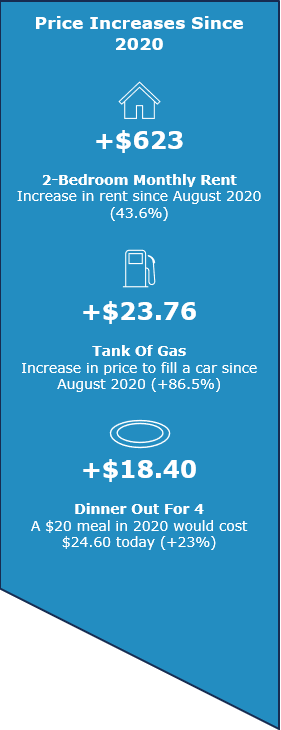
Because of inflation, today it costs the typical Arizona family over $2,700/year more to purchase the same goods and services as it would have cost in August 2022
. Even if the rate of inflation slows, it would take a sustained period of
deflation
to restore historical price levels.
Although average hourly wages in Arizona have increased 5.4% year-over-year, inflation has increased 3.7% causing a gain in real wages of 1.7% year-over-year. Wages continued their rapid increase, and in August inflation failed to outpace these increases and caused a gain in total wages. However, keeping in mind long-term rising inflation,
real wages in Arizona have fallen 9.4% since peaking in April 2020
.